2025 turned AI agents from demos into mainstream products. Computer-use agents moved into the spotlight (OpenAI Operator and ChatGPT agent), while Google pushed Agent Mode across Gemini and Chrome and Anthropic optimized for long-running agent workflows with Claude 4. Together, these releases made “agents” a real consumer and enterprise category, not just a research label. (OpenAI, OpenAI, blog.google, Anthropic)
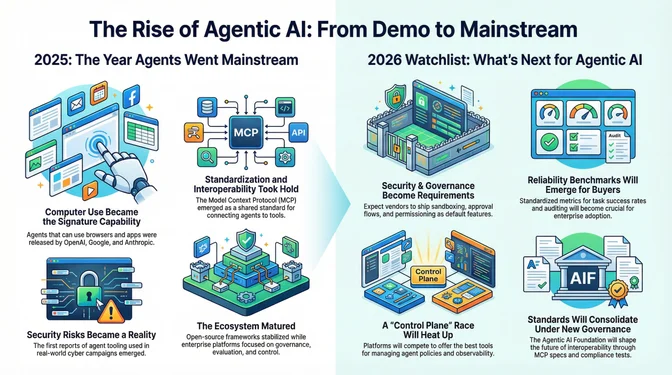
The bigger shift was platformization and standardization. OpenAI’s Responses API + tool stack and MCP support framed how agents connect to tools and data; Microsoft and Windows integrated MCP; and the Linux Foundation launched the Agentic AI Foundation with MCP, AGENTS.md, and goose as founding projects. Enterprise platforms like Copilot Studio, Agentforce, and Bedrock AgentCore focused on governance, evaluation, and control planes. (OpenAI, TechCrunch, The Verge, Linux Foundation, Microsoft, Salesforce, Amazon Web Services, Inc.)

Open-source frameworks stabilized (LangChain/LangGraph 1.0, LlamaIndex Workflows, Microsoft Agent Framework, Block’s goose), while security stopped being hypothetical after reports of agent tooling used in real-world cyber campaigns. (LangChain Blog, LlamaIndex, Microsoft for Developers, Block, The Guardian)

Timeline: 2025

January

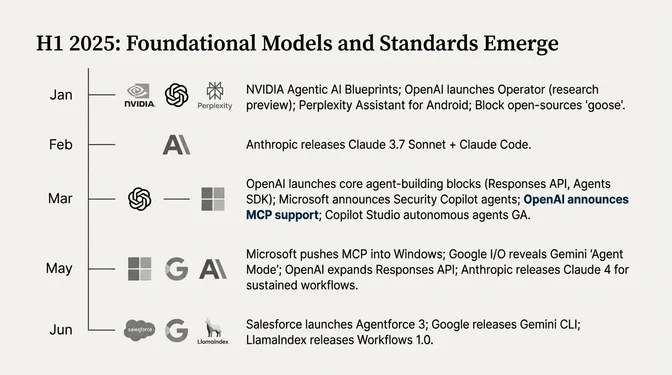
Jan 6 — NVIDIA launches “Agentic AI Blueprints” to help enterprises build agents that reason, plan, and act. (NVIDIA Blog)

Jan 23 — OpenAI launches Operator (research preview), a browser-using agent powered by a “Computer-Using Agent (CUA)” model. (OpenAI, Reuters)

Jan 23 — Perplexity launches Perplexity Assistant for Android (agent-like assistant with reasoning/search/app actions). (TechCrunch)

Jan 28 — Block open-sources “codename goose”, an interoperable agent framework for actions (initial focus: software engineering). (Block)

Jan 29 — ServiceNow announces agentic AI innovations positioned as “AI agents for every workflow.” (ServiceNow Newsroom)

February

Feb 24 — Anthropic releases Claude 3.7 Sonnet + Claude Code (hybrid reasoning; agentic coding tool). (Anthropic)

March

Mar 11 — OpenAI launches core agent-building blocks: Responses API, built-in tools, Agents SDK, and tracing; Assistants API sunset target set for mid-2026. (OpenAI)

Mar 24 — Microsoft announces Security Copilot agents for autonomous help in phishing, data security, and identity. (Microsoft)

Mar 26 — OpenAI announces MCP support across its products, signaling a shared tool-connection standard. (TechCrunch)

Mar 31 — Copilot Studio autonomous agents GA with deeper reasoning and MCP support (preview). (Microsoft)

May

May 19 — Microsoft pushes MCP into Windows via Windows AI Foundry and a registry concept. (The Verge)

May 20–21 — Google I/O: Gemini “Agent Mode” + Project Mariner with “teach and repeat” framing. (blog.google, The Verge)

May 21 — OpenAI expands Responses API: remote MCP servers, image generation, Code Interpreter, background mode, reasoning summaries, encrypted reasoning items. (OpenAI)

May 22 — Anthropic releases Claude 4 (Opus 4 + Sonnet 4) emphasizing sustained agent workflows. (Anthropic)

June

Jun 23–24 — Agentforce 3 launches with stronger interoperability and governance positioning. (Salesforce)

Jun 25 — Google releases Gemini CLI (open-source agent) aimed at developer workflows. (blog.google)

Jun 30 — LlamaIndex releases Workflows 1.0 for multi-step agentic systems. (LlamaIndex)

July

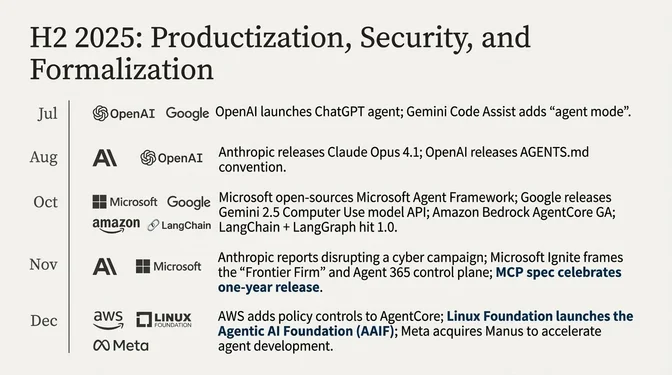
Jul 17 — OpenAI launches ChatGPT agent (“agent mode”) combining Operator-style web actions with deep-research-style synthesis. (OpenAI)

Jul 17 — Gemini Code Assist adds “agent mode” for multi-file planning and codebase-level work. (blog.google)

August

Aug 5 — Anthropic releases Claude Opus 4.1, improving agentic coding and reasoning. (Anthropic)

Aug 8 — ChatGPT agent expands to Enterprise/Edu. (OpenAI Help Center)

Aug 2025 — OpenAI releases AGENTS.md, a lightweight convention for project instructions. (OpenAI)

September

Sep 29 — Anthropic launches Claude Sonnet 4.5 with agent and computer-use strengths, plus a Claude Agent SDK and memory/context editing. (Anthropic)

October

Oct 2 — Microsoft introduces Microsoft Agent Framework (open-source) with interoperability support (MCP / A2A / OpenAPI). (Microsoft for Developers)

Oct 7 — Google releases Gemini 2.5 Computer Use model via API for UI-interacting agents. (blog.google)

Oct 13 — Amazon Bedrock AgentCore GA for AWS’s agent platform positioning. (Amazon Web Services, Inc.)

Oct 13 — Salesforce “Agentic Enterprise” announcement formalizes its Agentforce timeline. (Salesforce)

Oct 22 — LangChain + LangGraph hit 1.0 milestones for production agent frameworks. (LangChain Blog)

November

Nov 14 — Anthropic reports disrupting a cyber campaign involving Claude Code, highlighting misuse risk. (The Guardian)

Nov 18 — Microsoft Ignite: “Frontier Firm” framing + Agent 365 control plane, plus more Copilot agent modes and MCP in Teams channels. (Microsoft)

Nov 24 — Anthropic releases Claude Opus 4.5, emphasizing agentic and computer-use improvements. (Anthropic, Reuters)

Nov 25 — MCP’s one-year spec release signals maturation of the interoperability layer. (Model Context Protocol Blog)

December

Dec 2 — AWS adds policy controls + evaluations (preview) to AgentCore to scale agents safely with QA. (Amazon Web Services, Inc.)

Dec 9 — Linux Foundation launches the Agentic AI Foundation (AAIF) with MCP, goose, and AGENTS.md as founding contributions. (Linux Foundation)

Dec 9 — OpenAI details AGENTS.md adoption and contribution into AAIF. (OpenAI)

Dec 29 — Meta acquires Manus to accelerate general-purpose AI agents across Meta products. (Reuters, The Wall Street Journal, Business Insider)

Key Storylines (2025)

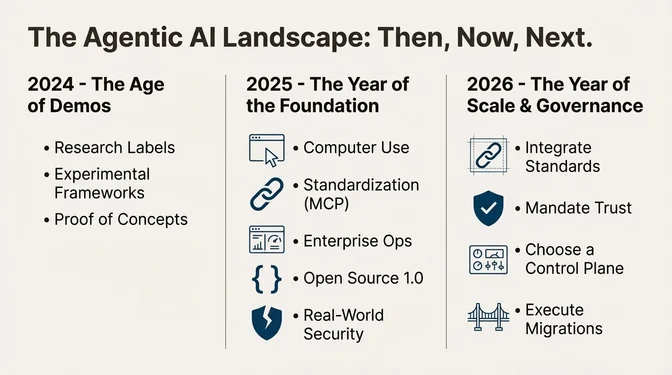
  1. Computer use becomes the signature capability (Operator, ChatGPT agent mode, Gemini Agent Mode/Mariner, Claude’s long-running computer-use push). (OpenAI)

  2. A tool-connection standard emerges (MCP) and spreads across ecosystems (OpenAI support, Microsoft Copilot Studio + Windows/Teams, Linux Foundation stewardship). (TechCrunch)

  3. Agent ops becomes real: governance, evals, policies, and control planes (Agent 365, Bedrock policies/evals, Salesforce governance framing). (Microsoft)

  4. Open-source agent engineering stabilizes (LangGraph/LangChain 1.0, LlamaIndex Workflows 1.0, Microsoft Agent Framework, goose). (LangChain Blog)

  5. Security stops being theoretical (prompt injection defenses and real-world misuse narratives become unavoidable). (OpenAI)

2026 Watchlist

1. Standards consolidation

When: 2026.

Context: AAIF governance and MCP roadmap will shape spec versions, compliance tests, and certified server ecosystems. Debate will sharpen around tool permissions, identity, and secure discovery (including registry concepts like Windows’ MCP registry). (Linux Foundation, The Verge)

Action: Track MCP spec updates, conformance tooling, and registry security models before standardizing internal agent integrations.

2. Agent security as a requirement

When: 2026 procurement cycles.

Context: “Agentic” systems expand the attack surface (prompt injection, credential leakage, tool poisoning). Vendors are shipping sandboxing, approval flows, and least-privilege tool access as defaults. (OpenAI)

Action: Require tool permissioning, audited execution logs, and red-team evaluations for any agent with production access.

3. Reliability benchmarks for buyers

When: 2026.

Context: Procurement-grade evaluation is likely to become standard (task success rates, rollback, audit logs, deterministic modes), especially for computer-use agents.

Action: Define success metrics and run recurring evals before deploying agents beyond supervised workflows.

4. Agent control planes get competitive

When: 2026.

Context: Microsoft’s Agent 365 framing, Bedrock policy/evals, and Salesforce’s governance narrative point toward a control-plane race. (Microsoft, Amazon Web Services, Inc., Salesforce)

Action: Inventory all agents, map access policies, and standardize observability and approvals across teams.

5. Developer platform migrations

When: By mid-2026.

Context: OpenAI’s Assistants API sunset target will force many teams to move to Responses API. (OpenAI)

Action: Plan a staged migration, including tool-call parity checks and eval baselines.
Keep Reading

No posts found