State of Databases 2026

February 16, 2026

Databricks spent $1 billion on Neon. Snowflake grabbed Crunchy Data for a reported $250 million. Supabase went from a $2 billion to $5 billion valuation in four months. 2025 had one thesis: PostgreSQL wins.
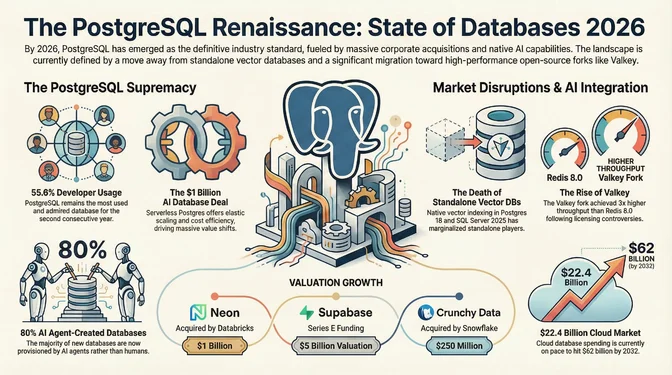
Infographic titled "The PostgreSQL Renaissance: State of Databases 2026" divided into two sections. The left side, "The PostgreSQL Supremacy," highlights 55.6% developer usage as the most used and admired database for the second consecutive year, and that AI agents created 80% of Neon's databases. The right side, "Market Disruptions & AI Integration," shows Redis 8.0 losing ground to the Valkey fork with 3x higher throughput, and standalone vector databases declining as PostgreSQL 18, Oracle 26ai, and SQL Server 2025 absorb vector search natively. A valuation growth section at the bottom tracks Neon acquired by Databricks for $1 billion, Supabase reaching $5 billion Series E, and Crunchy Data acquired by Snowflake for $250 million. The cloud database market reached $22.4 billion and analysts project it will hit $62 billion by 2032.
The PostgreSQL Renaissance: Billion-Dollar Bets on Open Source

The numbers back it up. PostgreSQL hit 55.6% usage in Stack Overflow's 2025 Developer Survey, making it the most used and most admired database for the second year running. It now powers Databricks' new Lakebase and Amazon Aurora DSQL; even Turso's $4.99/month edge databases run on Postgres. AI agents created over 80% of Neon's databases, not people.

PostgreSQL 18 shipped vector search through pgvector. Oracle rebranded its database "26ai" and bundled it free. SQL Server 2025 added DiskANN indexes. When three of the biggest database platforms ship the same feature in one year, the standalone vector database pitch gets a lot harder.

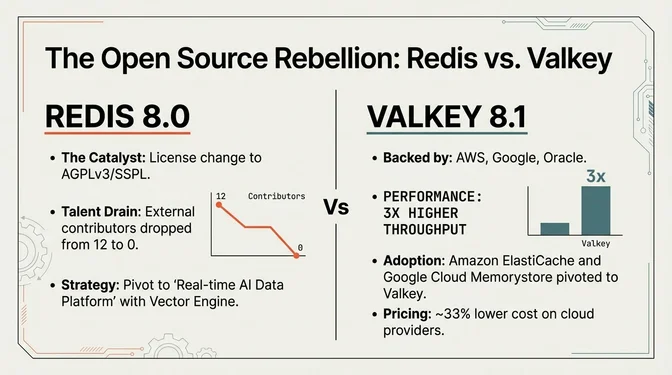
Redis learned that lesson the hard way. Redis 8.0 offered AGPLv3 as a license option, but the Valkey fork had already locked in AWS, Google, and Oracle, with benchmarks showing over 3x higher throughput. The damage from the 2024 license change was stark: the project went from 12 outside contributors handling 54% of commits to zero making more than five.

Security was brutal. Silk Typhoon breached the U.S. Treasury through a PostgreSQL injection chained with a BeyondTrust flaw. "MongoBleed" exposed credentials across 87,000 MongoDB instances. A researcher found 184 million passwords in an unprotected Elasticsearch database. The shakeout was real too. Fauna shut down in May, and the market is firmly rewarding consolidation. Cloud database spending hit $22.43 billion and is on pace for $62 billion by 2032.

Actions for 2026: Upgrade to PostgreSQL 18 for async I/O and UUIDv7. Try Valkey 8.1 as a Redis replacement. Patch MongoDB against MongoBleed if you're running affected versions.


Database 2025 Timeline

January 2025

January 3
release

Apache Paimon 1.0.0

Apache Paimon shipped 1.0.0 alongside improved Iceberg compatibility and REST catalog efforts, followed by 1.0.1 on February 10.
January 16
milestone

Snowflake Named DB-Engines DBMS of the Year 2024

Snowflake won DB-Engines "DBMS of the Year" for 2024, having gained the most popularity points and beating out PostgreSQL and Oracle.
January 18
release

Apache Hudi 1.0

Apache Hudi 1.0 reached GA, bringing DB-style capabilities to lake storage including a new secondary indexing system and other lakehouse management features.
January 20
milestone

Azure Database for MariaDB Retirement Approaches

With the September 19, 2025 retirement deadline for Azure Database for MariaDB approaching, Microsoft urged users to migrate to Azure Database for MySQL (Microsoft had already blocked new instance creation in 2024). MariaDB Corp entered 2025 under financial duress with SEC filings warning of "substantial doubt" about ability to continue as a going concern; the company secured a $26.5M financing agreement in October 2023 to stay afloat.
January 21
release

MySQL 9.2 Innovation Release

MySQL 9.2 (Innovation) shipped with JavaScript/MLE enhancements (Enterprise), performance improvements, and bug fixes; the VECTOR column type debuted earlier in MySQL 9.0 (July 2024). As an Innovation Release, MySQL 9.2 only receives support until MySQL 9.3's release—production users should use the 8.0.x or 8.4.x LTS tracks.

February 2025

February 13
security

PostgreSQL CVE-2025-1094 Disclosed

Rapid7's Stephen Fewer discovered CVE-2025-1094, a high-severity SQL injection flaw (CVSS 8.1) affecting PostgreSQL's psql client. Exploiting BeyondTrust's CVE-2024-12356 required chaining this vulnerability to achieve RCE. Chinese hacking group "Silk Typhoon" (APT27) had used these chained vulnerabilities to breach BeyondTrust Remote Support SaaS, affecting 17+ enterprise customers including U.S. Treasury Department workstations.
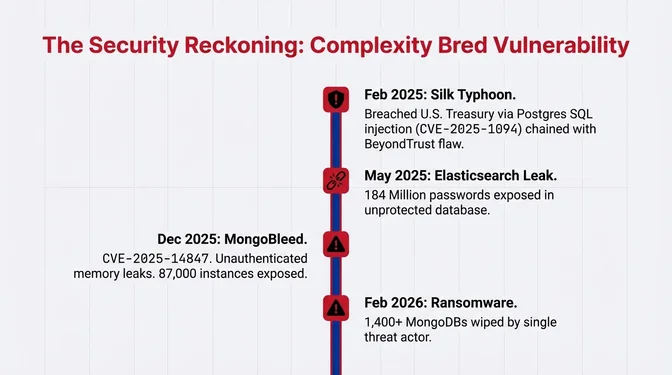
Vertical timeline titled "The Security Reckoning: Complexity Bred Vulnerability" showing four major database security incidents. February 2025: Silk Typhoon breached the U.S. Treasury via Postgres SQL injection (CVE-2025-1094) chained with a BeyondTrust flaw. May 2025: Elasticsearch leak exposed 184 million passwords in an unprotected database. December 2025: MongoBleed (CVE-2025-14847) caused unauthenticated memory leaks across 87,000 MongoDB instances. February 2026: ransomware attack wiped over 1,400 MongoDB databases by a single threat actor.
The Security Reckoning: Major Database Breaches 2025-2026

March 2025

March 4
release

Weaviate Launches AI Agents

Weaviate pivoted towards "Agentic AI", focusing on orchestration of the entire retrieval pipeline including native LLM integration for RAG and multi-modal search. Weaviate launched three AI-powered Agents: Query Agent for natural language to database queries, Transformation Agent for dataset enrichment at scale, and Personalization Agent for dynamic LLM-based personalization. Weaviate 1.20 added improved modular ML model support—plug in different vectorizers (OpenAI, Cohere, HuggingFace) to generate embeddings on the fly.
March 24
release

Apache Flink 2.0

Apache Flink 2.0 launched as the first major release in years, built around cloud-native, lakes, and AI use cases with disaggregated state management and deeper streaming-lakehouse integration including Paimon support.
March 25
release

PlanetScale Vectors GA

PlanetScale Vectors reached GA, adding vector storage and similarity search to PlanetScale's MySQL-as-a-service with doubled vector query performance and 8× improved memory efficiency compared to beta. Vector support for MySQL reached GA in April.
March 28
release

Valkey Search RC1

The Linux Foundation had launched Valkey as an open-source fork from Redis 7.2.4 in March 2024, backed by AWS, Google Cloud, Oracle, Ericsson, and Snap. In March 2025, valkey-search released its first release candidate, bringing vector search capabilities to the Valkey ecosystem. Led by former Redis maintainer Madelyn Olson, Valkey 8.0 GA (September 2024) achieved over 3x higher throughput and 1.2 million QPS on AWS r7g instances.
March 31
release

Valkey 8.1 GA

Valkey 8.1 became generally available with new hashtable implementation reducing memory overhead by 20-30 bytes per key, 3.5x faster iteration through memory prefetching, and 300% improved TLS connection acceptance rates.

April 2025

April 8
release

ScyllaDB 2025.1 LTS

ScyllaDB 2025.1 LTS enabled Tablets by default for better data distribution and introduced support for mixed instance-size clusters. ScyllaDB moved from AGPL to source-available licensing with 6.2.x as final OSS AGPL release, though a free tier (10TB storage, 50 vCPUs) remains available. In one third-party benchmark, ScyllaDB outperformed MongoDB by up to 20x in throughput-per-node on update-heavy workloads with P99 latencies below 10ms.
April 15
release

InfluxDB 3 Core and Enterprise GA

InfluxDB 3 Core and Enterprise reached GA, a complete rewrite from Go to Rust built on Apache Arrow, DataFusion, and Parquet, offering unlimited cardinality (solving the historical limit that plagued time-series DBs), columnar Parquet storage with vectorized execution, and dramatically faster performance. InfluxDB 3 Core targets recent data; a default query-planning limit corresponds to ~72 hours unless tuned, while Enterprise enables efficient longer-range queries via compaction and indexing.
release

Elasticsearch 9.0

Elasticsearch 9.0 released alongside 8.18, formally deprecating standalone Enterprise Search and merging capabilities directly into the core platform. Elasticsearch 7.17.x reached end of maintenance, with end of support scheduled for January 15, 2026. Elasticsearch embraced AI with the Elasticsearch Relevance Engine (ESRE), native vector search, transformer models for re-ranking, integration hooks to LLMs like GPT-4, and an AI Assistant for Kibana that answers questions about data in natural language. Apache Solr 9.3 also expanded vector search features including high-dimensional DenseVectorField support and SIMD-optimized similarity.
release

MySQL 9.3

MySQL 9.3 released continuing focus on AI—optimizing vector indexes and refining the JavaScript UDF engine. MySQL 8.0 remains under LTS support with 8.0.42 released April 2025 as a bug-fix rollup, receiving no new features.
April 24
milestone

Supabase Raises $200M Series D

Supabase raised $200 million Series D, reaching $2 billion valuation. Supabase's model bundles standard Postgres with best-of-breed tools (GoTrue, PostgREST) rather than building a proprietary engine.

May 2025

May 1
announcement

Redis 8.0 GA with AGPL Option

Redis 8.0 GA shipped with AGPLv3 as a third licensing option, making Redis tri-licensed (RSALv2/SSPLv1/AGPLv3). Redis creator Salvatore Sanfilippo (antirez) had rejoined the company in December 2024. Redis 8.0 integrated once-proprietary Redis Stack technologies—JSON, Time Series, and Query Engine into core under AGPL, plus introduced Vector Sets as the first new data type in years with 87% faster commands and 2x throughput. Community reaction remained skeptical; AWS had already committed to Valkey, and most Valkey adopters showed little interest in switching back.
Side-by-side comparison titled "The Open Source Rebellion: Redis vs. Valkey." Redis 8.0 on the left shows the license change to AGPLv3/SSPL as the catalyst, a declining line graph of external contributors dropping from 12 to zero, and a strategy pivot to real-time AI data platform with Vector Engine. Valkey 8.1 on the right shows backing by AWS, Google, and Oracle, a bar chart showing 3x higher throughput, adoption by Amazon ElastiCache and Google Cloud Memorystore, and approximately 33% lower cost on cloud providers.
The Open Source Rebellion: Redis License Fallout vs. Valkey Momentum
May 6
release

OpenSearch 3.0

OpenSearch 3.0 reached GA with 9.5x faster performance (also ~1.6× faster than "its closest industry competitor"), GPU-accelerated vector search via NVIDIA cuVS speeding up index construction by up to 9.3×, gRPC ingestion for higher throughput, Model Context Protocol (MCP) support for AI agent queries, and Derived Source storage optimization cutting storage by ~33%.
May 14
announcement

Databricks Agrees to Buy Neon for $1 Billion
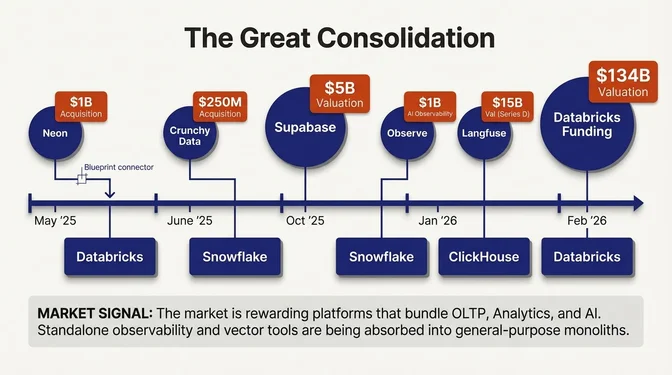
Timeline titled "The Great Consolidation" tracking major database acquisitions and funding from May 2025 through February 2026. Databricks buys Neon for $1 billion in May 2025, Snowflake buys Crunchy Data for $250 million in June 2025, Supabase reaches $5 billion valuation in October 2025, Snowflake acquires Observe for $1 billion AI observability in January 2026, ClickHouse raises $15 billion Series D and acquires Langfuse in January 2026, and Databricks completes a $134 billion valuation funding round in February 2026. Market signal at bottom: the market is rewarding platforms that bundle OLTP, analytics, and AI, while general-purpose monoliths absorb standalone observability and vector tools.
The Great Consolidation: Database M&A Timeline 2025-2026
May 22
security

184 Million Passwords Exposed in Elasticsearch

A massive data leak: a researcher found 184 million passwords exposed in an unsecured Elasticsearch database, belonging to a combolist of stolen credentials—a 10,000-record sample revealed hundreds of Google, Facebook, and Instagram accounts along with government portals and banking sites. Similar incidents included misconfigured Firebase Firestore exposing millions of records, an Elastic cluster leak affecting a major retailer, and attackers exploiting outdated MongoDB instances running 4.x to steal health records.
May 27
release

DuckLake Launch

DuckLake launched as DuckDB's new lakehouse format—SQL as a lakehouse format for unified analytics.
release

Amazon Aurora DSQL GA

Amazon Aurora DSQL reached general availability as a serverless distributed SQL database with active-active high availability, multi-Region strong consistency, and 99.99% single-Region / 99.999% multi-Region availability. GA added integrations including AWS Backup, PrivateLink, and an MCP server for AI applications.
May 30
announcement

Fauna Shuts Down

Fauna announced shutdown of operations, citing inability to raise enough capital.

June 2025

June 2
announcement

Snowflake Acquires Crunchy Data

Snowflake announced intent to buy Crunchy Data (deal value estimated around $250 million; terms not disclosed), adding enterprise-grade PostgreSQL expertise. Snowflake Postgres entered private preview. Snowflake also acquired Datometry for SQL dialect conversion tools and open-sourced pg_lake allowing PostgreSQL databases to query Iceberg tables in S3 directly.
June 4
release

CockroachDB 25.2 with Distributed Vector Indexing

CockroachDB 25.2 released with preview of distributed vector indexing (C-SPANN—adapted from Microsoft's SPANN research for fully distributed ANN with real-time index updates), up to 50% higher tpmC via KV batching, SQL auditing, and row-level TTL for privacy compliance. CockroachDB celebrated its 10th anniversary and deepened its AWS partnership with multi-region serverless clusters reaching GA. SIGMOD 2025 published research on CockroachDB's sub-second scaling. Free tier offers 5 GiB storage and 50M Request Units.
June 11
release

Databricks Lakebase Public Preview

Databricks announced "Lakebase" in public preview: a fully managed, ACID-compliant operational database built on the Postgres dialect, powered by Neon technology.
June 12
release

Milvus 2.6

Milvus 2.6 introduced RaBitQ 1-bit quantization achieving 72% memory reduction with 4x faster queries while maintaining 95% recall, plus 4x faster full-text search than Elasticsearch via enhanced BM25, 100x faster JSON filtering with Path Index, and zero-disk architecture for search freshness. In ANN benchmarks, Milvus demonstrated searching 1 billion vectors in under a second with high recall on a cluster using GPU acceleration. Zilliz Cloud launched globally with autoscaling, contributing to Ann-Benchmarks.com dataset evaluations. Facebook's FAISS and Google's ScaNN remain popular SDK choices, though lack of persistence drives users toward database solutions. Vendors collaborated on the emerging Vector Signal Standard (VSS) for data portability.
June 17
release

TimescaleDB Rebrands to TigerData

TimescaleDB's parent company renamed to TigerData, repositioning from time-series specialist to general-purpose data platform.
release

ScyllaDB X Cloud Launch

ScyllaDB X Cloud launched as truly elastic database-as-a-service scaling from 100K to 2M OPS in minutes.
June 20
announcement

Amazon Timestream for LiveAnalytics Deprecated

AWS deprecated Amazon Timestream for LiveAnalytics, closing it to new customers and recommending migration to Timestream for InfluxDB.
release

MongoDB 8.1 (Atlas)

MongoDB 8.1 released with aggregation, security, and performance improvements including enhanced Queryable Encryption with expanded encrypted query support for range queries. MongoDB 8.0 (late 2024) delivered 36% better read throughput, 56% faster bulk writes, ~200% faster complex time-series aggregations, and ~32% better performance in typical web-app benchmarks, plus sharding enhancements up to 50× faster. MongoDB positioned itself as the "memory" for AI agents, combining flexible document model with Atlas Vector Search.
June 30
release

DynamoDB Global Tables Multi-Region Strong Consistency

AWS launched multi-Region strong consistency (MRSC) for DynamoDB global tables, providing zero-RPO capability for region-wide events. MRSC requires three Regions and supports a two-replica-plus-witness topology, where the witness stores only replicated change data.

July 2025

July 8
announcement

Algolia Named Gartner Magic Quadrant Leader

Algolia earned Gartner Magic Quadrant Leader status for Search and Product Discovery. New Grow Plus pricing at $1.75 per 1,000 search requests adds AI Synonyms, AI Ranking, and Advanced Personalization.
July 9
release

Apache Polaris 1.0.0-incubating

Apache Polaris 1.0.0-incubating shipped as an Iceberg REST catalog implementation with binary distributions, official Helm chart, policy store, Postgres JDBC persistence, Quarkus runtime, and external IdP support. Polaris enables centralized access across engines and storage backends.
July 10
release

Oracle Database 23.5 "AI" Update

Oracle released Oracle Database 23.5 with Vector Search and Graph SQL/PGQ support, heavily marketing it as an "AI Database." Oracle 23c also features JSON Relational Duality—letting developers access data as JSON documents or relational tables interchangeably with full consistency. Oracle can also import or host pre-trained ML models inside the database for tasks like scoring and embeddings generation.
July 22
release

YugabyteDB 2025.2 Preview

YugabyteDB 2025.2 preview announced with disk-tiered storage for vector indexes, LangChain/LlamaIndex/OpenAI/Bedrock/Vertex AI integration via YugabyteDB MCP Server, MongoDB API compatibility (alongside YSQL and YCQL), and 1 billion+ vector support with HNSW indexes distributed across nodes. YugabyteDB moved all enterprise features—Distributed Backups, Data Encryption, Read Replicas to Apache 2.0 licensing in early 2025, eliminating the Community/Enterprise split.
July 23
release

AlloyDB Omni for Containers GA

Google shipped AlloyDB Omni GA for containers with PostgreSQL 16.8 support, Omni Kubernetes operator GA, and enterprise integrations including Active Directory authentication GA.
July 24
milestone

Valkey 8.1 on Amazon ElastiCache

Valkey 8.1 became generally available on Amazon ElastiCache, cementing the fork as a first-class option in cloud infrastructure with 33% lower pricing than Redis OSS. By late 2025, RHEL 10 ships Valkey 7.2, while Debian 13 (trixie) offers a choice of Redis 8 or Valkey. The Valkey 2025 year-end report documented the fork's rapid adoption.
July 26
release

Neon Agent Plan

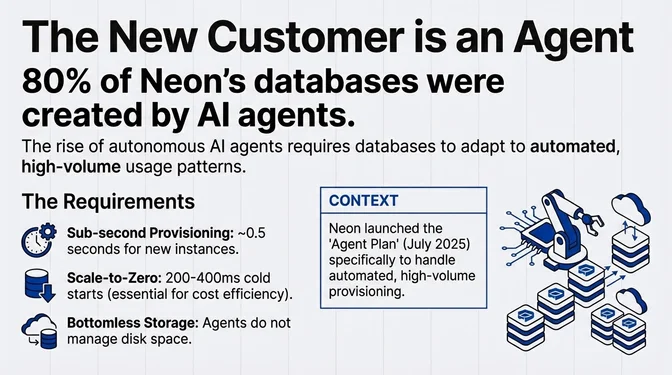
Neon introduced the Agent Plan with custom resource limits specifically designed for AI platforms provisioning thousands of databases. Neon also offers branching with masked PII—enabling safe, fast production clones for testing without exposing sensitive data. Neon's "bottomless" storage with sub-second database provisioning (~0.5 seconds for new instances) and scale-to-zero with 200-400ms cold starts made it ideal for AI agent workloads.
Graphic headlined "The New Customer is an Agent" showing that AI agents created 80% of Neon's databases. Lists three requirements for AI agent database workloads: sub-second provisioning at approximately 0.5 seconds for new instances, scale-to-zero with 200-400ms cold starts for cost efficiency, and bottomless storage where agents do not manage disk space. A context box notes Neon launched the Agent Plan in July 2025 specifically to handle automated high-volume provisioning.
The New Customer Is an Agent: AI-Driven Database Provisioning
July 29
release

Qdrant Edge Launch

Qdrant Edge launched as a lightweight vector database for robots, kiosks, mobile devices, and embedded systems.
July 31
release

Turso Serverless JavaScript Driver

Turso launched its serverless JavaScript driver using pure HTTP communication via fetch(), working on Cloudflare Workers, Vercel Edge Functions, and Deno Deploy. Turso's pricing model disrupted the market: $4.99/month for unlimited databases (500 monthly active limit) makes database-per-tenant architectures 100-1000x cheaper. In October 2025, Turso followed up with a concurrent writes preview, overcoming SQLite's single-writer limitation via Rust-based rewrite maintaining ACID compliance via MVCC.
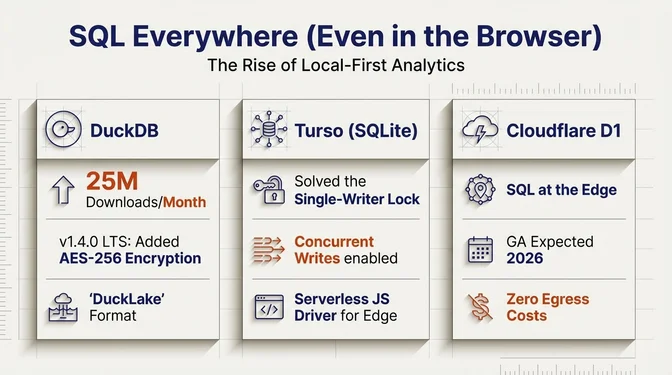
Three-panel comparison titled "SQL Everywhere (Even in the Browser): The Rise of Local-First Analytics." The DuckDB panel shows 25 million downloads per month, v1.4.0 LTS adding AES-256 encryption, and the new DuckLake format. The Turso (SQLite) panel shows it solved the single-writer lock, enabled concurrent writes, and launched a serverless JavaScript driver for edge deployment. The Cloudflare D1 panel shows SQL at the edge, GA expected in 2026, and zero egress costs.
SQL Everywhere: DuckDB, Turso, and Cloudflare D1 Push Data to the Edge

August 2025

August 8
release

Redis 8.2 GA

Redis 8.2 reached GA with over 35% faster command execution and ~49% higher throughput versus Redis 8.0, plus up to 67% memory reduction in some cases. Redis positioned itself as a high-performance vector database with Redis Vector Engine for real-time AI use cases. Redis Inc. also leaned into Redis Cloud AutoScaling (elastic scaling with shard rebalancing) and Change Data Capture (CDC) streams to integrate Redis as a real-time layer on top of relational databases. RedisJSON 2.0 delivered 4x faster JSON parsing and retrieval.
August 14
security

PostgreSQL CVE-2025-8714 and CVE-2025-8715

PostgreSQL Global Development Group released critical security fixes for CVE-2025-8714 and -8715—two vulnerabilities in pg_dump/backup restore process allowing arbitrary code execution (both scored CVSS 8.8). Also fixed was CVE-2025-8713, a lower-severity leak in optimizer statistics that could let users bypass row security policies. Other 2025 CVEs included CVE-2025-12818 (integer wraparound in libpq), CVE-2025-12817 (DoS via CREATE STATISTICS), and CVE-2025-13780 in pgAdmin (remote code execution, fixed in pgAdmin 9.11).
August 25
release

MySQL HeatWave 9.4.1 GA

MySQL HeatWave 9.4.1 reached GA with AutoML for training ML models inside MySQL and vector similarity queries, effectively allowing MySQL HeatWave to serve as a vector database for AI applications. HeatWave GenAI updates expanded Oracle's positioning of MySQL as an AI-ready platform.

September 2025

September 4
announcement

Neo4j Infinigraph

Neo4j announced Neo4j Infinigraph at GraphConnect, billed as the "most scalable graph database" targeting 100+ TB graphs with distributed storage, query processing, HTAP capabilities, and vector embeddings directly on tens of millions of graph nodes. Neo4j also added Model Context Protocol (MCP) for AI agent integration, switched to calendar versioning in January 2025, and now supports the GQL (Graph Query Language) standard—the first new ISO database language since SQL in 1987. TigerGraph refocused on enterprise fraud detection and supply chain after staff cuts with usage-based cloud pricing. Amazon Neptune added openCypher support and neural search features for similarity search on vectors attached to nodes.
September 11
release

Apache Iceberg 1.10.0

Apache Iceberg 1.10.0 shipped with continued improvements to the open table format that has become the de facto lakehouse standard.
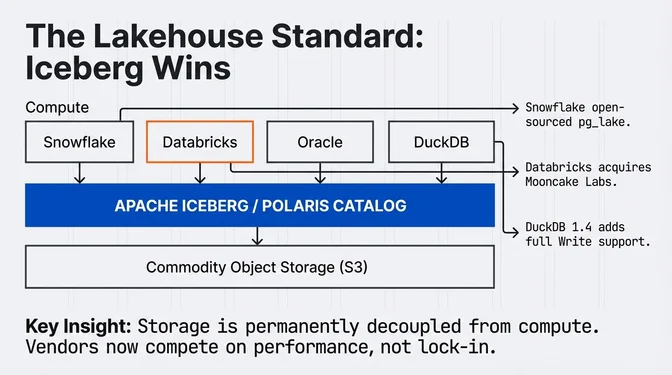
Architecture diagram titled "The Lakehouse Standard: Iceberg Wins" showing a three-tier stack. At the compute layer, Snowflake, Databricks, Oracle, and DuckDB all feed into a shared Apache Iceberg / Polaris Catalog layer, which sits on top of commodity object storage (S3). Annotations note Snowflake open-sourced pg_lake, Databricks acquired Mooncake Labs, and DuckDB 1.4 added full write support. Key insight at bottom: storage is permanently decoupled from compute, and vendors now compete on performance, not lock-in.
The Lakehouse Standard: Apache Iceberg Unifies the Data Stack
September 16
release

DuckDB 1.4.0 "Andium" LTS

DuckDB introduced its first Long-Term Support release with v1.4.0. The marquee feature is AES-256-GCM database encryption for files, WAL, and temporary storage. DuckDB sees almost 25 million monthly downloads on PyPI and DB-Engines flagged it as a "system to watch". Security patches addressed CVE-2025-64429 in version 1.4.2.
September 23
announcement

Algolia Agent Studio Launch

Algolia launched Agent Studio, enabling developers to build AI-powered search agents with natural language query understanding.
September 25
release

PostgreSQL 18.0

PostgreSQL 18.0 officially released with async I/O subsystem (configurable via io_method parameter supporting worker, io_uring on Linux, or sync) promising up to 3x performance improvements in scan-heavy analytical queries, native UUIDv7 generation (resolving B-tree fragmentation from random UUIDv4s), OAuth 2.0 authentication, skip scan lookups, temporal constraints, virtual generated columns, and parallel GIN index builds. DB-Engines ranked PostgreSQL as March's second-biggest climber and a top climber in 4 of the last 6 months.
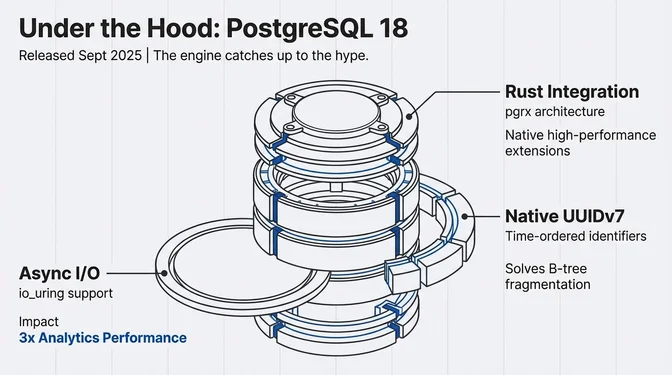
Technical diagram titled "Under the Hood: PostgreSQL 18" released September 2025, showing an exploded-view engine illustration with three major features labeled. Async I/O via io_uring support delivers 3x analytics performance. Native UUIDv7 provides time-ordered identifiers that solve B-tree fragmentation. Rust Integration via pgrx architecture enables native high-performance extensions.
Under the Hood: PostgreSQL 18 Performance and Extensibility
release

Delta Lake 4.0

Delta Lake 4.0 shipped with catalog integration work (preview), "variant" data type for semi-structured data, and performance/metadata improvements.
September 30
release

MongoDB Vector Search for Self-Managed

MongoDB extended vector search to self-managed deployments, moving beyond Atlas-exclusive model to support Community Edition and Enterprise Server.
announcement

Weaviate Search Mode GA

Weaviate Search Mode reached GA with +17% improvement in Success@1 and +11% in Recall@5 versus standard hybrid search.

October 2025

October 1
announcement

Databricks Acquires Mooncake Labs

Databricks acquired Mooncake Labs to speed up PostgreSQL-Iceberg integration for Lakebase. PlanetScale launched PlanetScale for Postgres—managed sharded PostgreSQL on AWS or Google Cloud with PlanetScale Metal offering NVMe-based clusters with "Unlimited I/O."
release

SingleStore Aura Analyst

Private equity took majority ownership of SingleStore in September 2025. Aura Analyst launched as natural language analytics assistant converting queries to SQL. SingleStore promoted its Wasm UDF capability (running WebAssembly modules inside DB) to let developers bring custom AI logic close to data.
October 3
release

Supabase $5B Valuation

Supabase reached $5 billion valuation with $100 million Series E, just four months after hitting $2 billion. With over 4 million developers and 100,000+ customers (including PwC, McDonald's, GitHub Next), Supabase announced postgres.new (an LLM-powered browser-based Postgres interface), asymmetric JWT authentication, plans for Apache Iceberg integration, and hired Vitess co-creator Sugu Sougoumarane to build "Multigres" for enterprise-scale horizontal sharding.
October 6
release

QuestDB 9.1

QuestDB 9.1 shipped with nanosecond timestamp precision (TIMESTAMP_NS) for high-frequency trading and sensor data, integrated continuous profiling, and auto-scaling symbol maps. Benchmarks against InfluxDB 3 Core showed QuestDB 12-36x faster for ingestion (up to 11.4M rows/sec vs 320K rows/sec) and 17-418x faster for queries depending on type.
October 8
release

PingCAP TiDB X

PingCAP launched TiDB X at SCaiLE Summit with a new distributed SQL architecture with object storage backbone, truly decoupled compute/storage, and unified query engine fusing vectors, knowledge graphs, JSON, and SQL. TiDB AI SDK, Reasoning Engine, and MCP Server integrations enable direct connections to Cursor, Claude Code, VS Code, and WindSurf. TiDB's columnar engine (TiFlash) got 30% speed boost, and they introduced an AI coprocessor plugin for running TensorFlow Lite models inside DB.
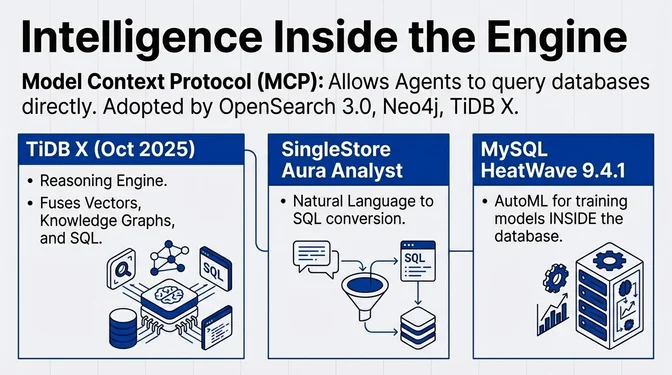
Graphic titled "Intelligence Inside the Engine" showing AI capabilities built directly into database engines via Model Context Protocol (MCP), adopted by OpenSearch 3.0, Neo4j, and TiDB X. Three product examples: TiDB X (October 2025) with a Reasoning Engine fusing vectors, knowledge graphs, and SQL; SingleStore Aura Analyst with natural language to SQL conversion; and MySQL HeatWave 9.4.1 with AutoML for training models inside the database.
Intelligence Inside the Engine: Databases Absorb AI Natively
October 10
milestone

Apache Derby Enters Read-Only Mode

Apache Derby entered "read-only mode" after no maintainers stepped up. Cloudera announced it would wind down Cloudera Data Platform Private Cloud, shifting focus to hybrid cloud services.
October 14
announcement

Oracle Database 26ai

Oracle announced AI Database 26ai at Oracle AI World, featuring AI Vector Search included at no extra charge—a direct shot at vector database vendors. Apache Iceberg support across OCI, AWS, Azure, and GCP. DB-Engines Q3 2025 report showed Snowflake as top gainer, followed by Databricks and Splunk.
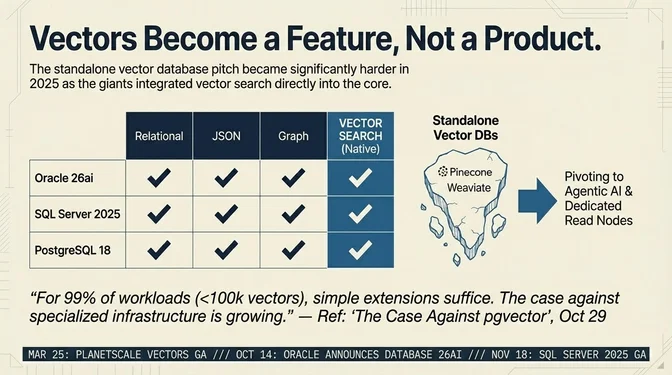
Comparison table titled "Vectors Become a Feature, Not a Product" showing Oracle 26ai, SQL Server 2025, and PostgreSQL 18 all supporting relational, JSON, graph, and native vector search capabilities. The graphic shows standalone vector databases like Pinecone and Weaviate as a shrinking ice mass, pivoting to Agentic AI and dedicated read nodes. A quote reads: "For 99% of workloads under 100k vectors, simple extensions suffice. The case against specialized infrastructure is growing." A timeline bar at the bottom shows PlanetScale Vectors GA in March 2025, Oracle Database 26ai announced in October, and SQL Server 2025 GA in November.
Vectors Become a Feature: General-Purpose Databases Absorb Vector Search
October 16
release

AWS InfluxDB 3 Support

AWS launched InfluxDB 3 support with multi-node cluster configurations and S3-based storage.
October 21
release

Couchbase 8.0

Couchbase 8.0 released with Hyperscale Vector Indexing for billion-scale vector search with millisecond latency.
October 21–24
event

PGConf.EU 2025 — Riga, Latvia

PGConf.EU 2025 took place in Riga, Latvia with sessions including "Vector data in Postgres: Size, TOAST, Filters and Performance", "Hacking pgvector for performance", and a keynote by Karen Sandler on "The Foundation of Open Source: Why Software Freedom?"
October 25
release

TimescaleDB 2.23.0 and pgvectorscale

TimescaleDB 2.23.0 added full PostgreSQL 18 support with UUIDv7 compression enabled by default—delivering 30%+ storage savings and 2x faster queries. TimescaleDB also released pgvectorscale, reporting 28× lower p95 latency on 10M-vector benchmarks compared to vanilla pgvector. Notable adoption: CERN uses TimescaleDB to power ground-breaking physics research, demonstrating ability to ingest millions of metrics per second.
October 29
announcement

"The Case Against pgvector"

Alex Jacobs' well-circulated blog post _"The Case Against pgvector"_ argued that for 99% of workloads with <100k vectors, a simple extension suffices—warning not to overcomplicate DBMSs at the expense of performance and reliability.
October 31
milestone

Cloud Database Market Reaches $22.4B

Cloud infrastructure spending reached almost $99 billion in Q2 2025 (~24–25% YoY growth). AWS holds 30% market share, Microsoft Azure 20%, Google Cloud 13%. The cloud database market specifically reached $22.43 billion, projected to hit $62.25 billion by 2032 (15.7% CAGR). GenAI-specific cloud services grew ~140–180% YoY in Q2 2025. The question is shifting from "which database engine?" to "which data platform?" Global cloud market expected to surpass $1 trillion in early 2026. #### [milestone] MariaDB Under New Ownership In September 2024, K1 Investment Management acquired MariaDB, taking it private and removing it from the NYSE. The acquisition followed restructuring including ~28% staff cuts and dropping cloud products (SkySQL DBaaS and Xpand engine) to refocus on core server. The MySQL user community has become more reliant on Percona for stable releases and support.

November 2025

November 13
release

PostgreSQL 18.1

PostgreSQL 18.1 released marking PostgreSQL 13's EOL with 13.23 as final release.
November 18
release

SQL Server 2025 GA

Microsoft SQL Server 2025 reached general availability, positioning itself as the most AI-integrated enterprise database with native vector data type with DiskANN indexes, native JSON support up to 2GB per row, built-in regular expressions in T-SQL, REST API support via sp_invoke_external_rest_endpoint for calling Azure AI Foundry/OpenAI/Ollama from within SQL, Intelligent Query Processing improvements, Optional Parameter Plan Optimization (OPPO), and Fabric Mirroring for near-real-time analytics replication to Microsoft Fabric OneLake in Delta Parquet format. Platform support expanded to RHEL 10 and Ubuntu 24.04 with TLS 1.3. Express edition now supports 50GB databases (up from previous limits). Microsoft has hinted at AI-assisted query optimization and natural language query features in future releases.
November 19
announcement

Azure HorizonDB Unveiled

At Ignite 2025, Microsoft unveiled Azure HorizonDB, a cloud-native distributed PostgreSQL service with disaggregated compute and storage, directly targeting Amazon Aurora. HorizonDB features auto-scaling shared storage up to 128TB independent of compute (up to 3,072 vCores), and integrated DiskANN indexing for low-latency vector searches on datasets exceeding system memory.
November 2025
milestone

Gartner Magic Quadrant for Cloud Database Management Systems

Gartner published its 2025 Magic Quadrant for Cloud Database Management Systems (dated Nov 18, 2025). Four vendors—including Google, Databricks, MongoDB, and IBM—state Gartner named them Leaders in the 2025 report (see the full Gartner document for the complete quadrant).
November 25
release

Qdrant 1.16

Qdrant 1.16 delivered tiered multitenancy and ACORN algorithm for improved filtered HNSW queries.
November 28
release

Prometheus v3.8.0

Prometheus v3.8.0 released (tagged 2025-11-28) with native histograms reaching stable status after years in experimental.
November 30
event

AWS re:Invent 2025

December 2025

December 1
release

Pinecone Dedicated Read Nodes

Pinecone launched second-generation serverless architecture in February 2025, designed to automatically optimize for diverse workloads. Dedicated Read Nodes followed in December for predictable billion-vector-scale performance—one customer achieved 600 QPS sustained at P50 latency of 45ms across 135 million vectors. Pinecone announced a Microsoft partnership for Azure integration. Pinecone raised $100M Series B in early 2023 (at $750M valuation) and $200M at ~$1B+ valuation in late 2024. Weaviate secured a Salesforce partnership to power some Einstein GPT searches, positioned with Apache 2.0 license.
December 2
release

Amazon S3 Tables Replication and S3 Vectors GA

AWS added replication support and Intelligent-Tiering for S3 Tables to maintain consistent Iceberg table replicas across Regions without manual synchronization. Separately, Amazon S3 Vectors became generally available with native vector storage and querying, scaling up to 2 billion vectors per index with ~100ms query latencies.
December 10
security

MongoDB CVE-2025-14847 "MongoBleed"

CVE-2025-14847 "MongoBleed", a critical MongoDB vulnerability (CVSS 8.7 v4.0 / 7.5 v3.1) enabling unauthenticated remote memory leaks via zlib compression, extracting credentials, session tokens, and API keys. 87,000+ potentially vulnerable instances identified worldwide.
December 17
release

AWS Aurora PostgreSQL 18.1 Preview

AWS Aurora PostgreSQL 18.1 entered preview. Google Cloud SQL added pgvector 0.8.0 alongside DiskANN vector indexing preview. Azure Database for PostgreSQL Flexible Server gained PostgreSQL 18 support with near-zero downtime scaling. Google Cloud Spanner launched "Spanner Data Boost" for easier analytical queries with PostgreSQL 15 compatibility mode and vector data type preview. Azure Cosmos DB for PostgreSQL (Citus-based) gained columnar storage for faster scans and preview of pgvector across shards.
December 18
release

AlloyDB Managed Connection Pooling GA

Google made managed connection pooling GA for AlloyDB, a built-in pooling feature to optimize resource usage and improve scalability, compatible with the AlloyDB Auth Proxy and language connectors.

January 2026

January 8
announcement

Snowflake Acquires Observe for ~$1 Billion

Snowflake announced intent to buy Observe, an AI-powered observability platform, for approximately $1 billion, Snowflake's largest acquisition to date surpassing the $800M Streamlit deal. The acquisition completed on February 2, enabling faster troubleshooting of AI agents and data pipelines directly within the Snowflake platform.
January 16
milestone

ClickHouse $400M Series D and Langfuse Acquisition

ClickHouse raised $400 million in Series D funding led by Dragoneer Investment Group, tripling its valuation to $15 billion. Simultaneously, ClickHouse acquired Langfuse, the leading open-source LLM observability platform with 20K+ GitHub stars, 26M+ monthly SDK installs, and 2,000+ paying customers including 19 of the Fortune 50. Langfuse remains 100% open-source under MIT license.
January 20
security

Oracle Critical Patch Update

Oracle's January 2026 Critical Patch Update addressed database vulnerabilities across Oracle's product portfolio. Oracle released five new GoldenGate security patches, three remotely exploitable without authentication.
January 26
release

DuckDB 1.4.4 LTS

DuckDB 1.4.4 shipped with bugfixes, performance improvements, and security patches for the 1.4 LTS line. DuckDB-Wasm now supports the Iceberg extension for serverless, in-browser interaction with Iceberg REST Catalogs. Version 1.5.0 targets February 2026, with 1.4 LTS supported until mid-September.
January 27
release

Oracle 26ai GA On-Premises

Oracle Database 26ai reached general availability for Linux x86-64 on-premises, featuring AI Vector Search at no extra charge, RAFT-based globally distributed replication, in-database SQL firewall, quantum-resistant encryption, True Cache, JSON Relational Duality, and Apache Iceberg Lakehouse support.
January 31
event

FOSDEM 2026 Databases Track

FOSDEM 2026 took place January 31–February 1 in Brussels with a dedicated databases track covering inverted database indexes, benchmarks, and modern database architecture.

February 2026

February 2
security

1,400+ MongoDB Databases Ransacked

February 4
release

MariaDB Q1 2026 Maintenance Releases

MariaDB shipped Q1 2026 maintenance releases—Community Server versions 11.8.6, 11.4.10, 10.11.16, and 10.6.25. MariaDB 12.3 targets Q2 2026 as the first LTS release under the new policy where each major version's .3 release becomes LTS.
February 9
milestone

Databricks Completes $5 Billion Funding Round

Databricks completed a $5 billion equity funding round plus $2 billion in debt capacity, reaching a $134 billion valuation. Annualized revenue exceeded $5.4 billion for the January quarter, up 65% year-over-year.

Database 2026 Watchlist

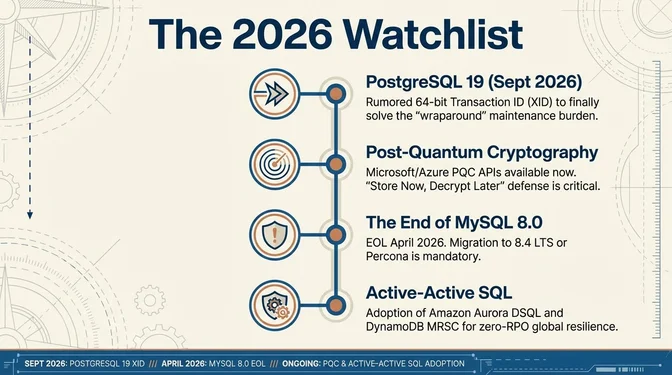
Roadmap graphic titled "The 2026 Watchlist" listing four items on a vertical timeline. PostgreSQL 19 expected September 2026 with rumored 64-bit Transaction ID (XID) to solve the wraparound maintenance burden. Post-Quantum Cryptography with Microsoft and Azure PQC APIs available now, noting that "Store Now, Decrypt Later" defense is critical. The End of MySQL 8.0 with EOL in April 2026, making migration to 8.4 LTS or Percona mandatory. Active-Active SQL with adoption of Amazon Aurora DSQL and DynamoDB MRSC for zero-RPO global resilience. A timeline bar at bottom marks PostgreSQL 19 XID in September 2026, MySQL 8.0 EOL in April 2026, and ongoing PQC and active-active SQL adoption.
The 2026 Watchlist: Critical Database Deadlines and Migrations

1. PostgreSQL 19

When: September 2026
Context: Development continues with rumored 64-bit Transaction ID (XID) to solve decades-old "transaction wraparound" issue—a critical maintenance burden for massive Postgres clusters. May also include built-in pgvector indexing merged into core. Adoption of Rust via pgrx will grow for high-performance extensions. PostgreSQL MD5 authentication, deprecated in version 18, faces removal as SCRAM-SHA-256 becomes mandatory.
Action: Track PostgreSQL 19 development. Plan upgrade from PostgreSQL 17 or earlier given PostgreSQL 13 is now EOL.


2. Valkey 9.0 and Redis Competition

When: Q1-Q2 2026
Context: Valkey 8.1 achieves 28% lower memory usage than Redis while cloud providers offer 33% lower pricing. Redis Software 7.2 (based on BSD-licensed Redis OSS 7.2) reaches EOL Feb 28, 2026, forcing migration decisions. Valkey patched security CVEs in 9.0 release candidates.
Action: Plan Valkey migration before Redis 7.2 EOL. Benchmark Valkey 8.1 against Redis 8.2 for your workload. Consider cloud provider pricing differences.


3. Snowflake Postgres GA

When: H1 2026
Context: Following Crunchy Data acquisition (estimated ~$250M), Snowflake Postgres is in private preview. Snowflake also acquired Datometry for SQL dialect conversion tools. Snowflake open-sourced pg_lake allowing PostgreSQL databases to query Iceberg tables in S3 directly, effectively turning every Postgres instance into a potential Lakehouse node.
Action: Sign up for Snowflake Postgres preview if using Snowflake for analytics. Test pg_lake for bridging operational Postgres with lakehouse analytics.


4. MySQL 8.4 LTS Transition

When: Throughout 2026
Context: MySQL 8.0 reaches EOL in April 2026 (ending with 8.0.46 per Oracle's release notes). MySQL 8.4 LTS expected to replace 8.0 as the Long-Term Support track. Oracle laid off dozens of MySQL engineers—up to 70 senior MySQL developers in September 2025, raising community concerns about Oracle's commitment.
Action: Plan MySQL 8.0 to 8.4 LTS migration. Consider Percona Server for MySQL or MariaDB as alternatives given Oracle's uncertain commitment.


5. Vector Database Consolidation

When: Throughout 2026
Context: With PostgreSQL 18, Oracle 26ai, and SQL Server 2025 all offering native vector indexing, standalone vector databases face uncertain futures. PostgresML, Hydra, and Voltron Data faced struggles or shutdowns—their "AI-on-Postgres" value propositions overtaken by the core Postgres project's own rapid evolution. Expect at least one major acquisition (e.g., cloud provider buying vector DB startup). Purpose-built vector databases will narrow to specialized high-performance use cases as integrated solutions mature. M&A speculation includes Cloudera and Couchbase joining forces, and SAP HANA may spin off or get more open.
Action: Test whether pgvector or integrated database vector capabilities can replace standalone vector databases. For billion-scale embeddings, benchmark Pinecone, Milvus, and Qdrant. Watch for acquisition announcements.


6. Apache Iceberg Ubiquity

When: Now
Context: Apache Iceberg won the table format war. Microsoft Fabric, Oracle 26ai, Snowflake, and Databricks all offer native Iceberg read/write. DuckDB 1.4.2 gained full Iceberg write support (INSERT, UPDATE, DELETE). This forces vendors to compete on compute engine performance rather than storage format lock-in. Snowflake open-sourced pg_lake allowing PostgreSQL databases to query Iceberg tables directly.
Action: Standardize on Iceberg for new data lake workloads. Plan migration from Delta Lake or Hudi. Use pg_lake or similar tools to bridge OLTP and analytics.


7. Post-Quantum Cryptography in Databases

When: Throughout 2026
Context: Microsoft made PQC algorithms (like ML-KEM) generally available across Windows and Azure platform APIs, with hybrid PQC key exchange coming to the Windows TLS stack—databases running on these platforms can inherit PQC-capable TLS connections. Oracle 26ai features quantum-resistant encryption. "Store Now, Decrypt Later" threats drive early adoption, and first operational mandates for Post-Quantum Cryptography appeared in 2025.
Action: Review PQC-ready database options for sensitive data. Check TLS configurations for quantum resistance. Databases on Windows/Azure can leverage platform-level PQC APIs for encrypted connections.


8. Aurora DSQL and Active-Active Distributed SQL

When: Throughout 2026
Context: Aurora DSQL's active-active architecture with multi-Region strong consistency may set a new expectation for OLTP databases. DynamoDB's multi-Region strong consistency with witness topology enables zero-RPO without full replica costs.
Action: Test Aurora DSQL for new globally distributed workloads. Consider DynamoDB MRSC witness topology for cost-effective global durability.


9. Open Table Formats and Streaming-Lakehouse

When: Throughout 2026
Context: Consolidation shifts from "which format" to "which catalog + governance + engine interoperability." Iceberg 1.10, Delta Lake 4.0, Hudi 1.0, and Paimon 1.0 all reached maturity in 2025. Apache Polaris positions itself as an Iceberg REST-based catalog layer. Flink 2.0 pushes streaming-lakehouse patterns into a unified stack.
Action: Standardize catalog layer (Polaris, Unity, Gravitino). Test Flink 2.x + Paimon for operational-to-analytical pipelines.


10. S3 Tables and Storage-First Database Patterns

When: Throughout 2026
Context: S3 Tables added cross-Region Iceberg replication and Intelligent-Tiering. S3 Vectors reached GA scaling to 2 billion vectors per index with ~100ms latencies. Together they normalize a "storage-first database" pattern shifting workload gravity from specialized services into object storage.
Action: Test S3 Vectors for cost-sensitive vector workloads not requiring sub-10ms latency. Consider S3 Tables replication for cross-Region lakehouse consistency.


11. AI Agent Database Workloads

When: Now
Context: Over 80% of Neon databases created by AI agents. Neon's Agent Plan offers custom resource limits for AI platforms. Gartner predicts AI agents will intermediate most B2B work by 2026—"Self-Driving" database capabilities moving from marketing hype to reality. Sub-second provisioning and scale-to-zero become essential. 74% of IT leaders expect budget increases in 2026 with AI readiness becoming core architectural mandate.
Action: Test Neon, Turso, or Supabase for AI agent workloads needing instant database provisioning. Add rate limiting and cost controls for agent-initiated database creation.


12. DuckDB and Embedded Analytics

When: Now
Context: DuckDB 1.4.0 "Andium" introduced first LTS release with AES-256-GCM encryption. With almost 25 million monthly downloads on PyPI. DuckLake launched as new lakehouse format. Turso's breakthrough with concurrent writes overcame SQLite's single-writer limitation.
Action: Try DuckDB for local analytics and data transformation pipelines. Consider Turso for edge and serverless applications requiring SQLite compatibility with write concurrency.


13. OpenSearch 3.x and Model Context Protocol

When: Now
Context: OpenSearch 3.0 delivered 9.5x faster performance with GPU-accelerated vector search and Model Context Protocol (MCP) support allowing AI agents to query search indexes. AWS announced GPU acceleration for vector operations at re:Invent 2025.
Action: Upgrade from OpenSearch 1.x (deprecated May 2025). Test MCP integration for AI agent applications. Consider GPU-accelerated indexing for large vector workloads.


14. Vector Search Quality and Correctness

When: Ongoing
Context: Using vector search for mission-critical tasks (medical, legal document retrieval) raises quality concerns—issues of drift, bias, and false positives in nearest-neighbor search need addressing. Research emerged in 2025 on "safe vector search": algorithms to quantify uncertainty of vector matches and hybrid approaches that cross-verify with symbolic searches.
Action: Use hybrid search (combining vectors with keyword/BM25) as default pattern. Add uncertainty quantification for high-stakes vector queries. Cross-verify vector results with traditional search for critical applications.


15. Cloudflare D1 and Edge SQL

When: 2026
Context: Cloudflare D1 (essentially a hosted SQLite with Durable Objects) should reach GA—enabling SQL at the edge. **Turso** disrupted the market with $4.99/month for unlimited databases (500 monthly active limit), making database-per-tenant architectures 100-1000x cheaper. Turso's serverless JavaScript driver uses pure HTTP communication via fetch(), working on Cloudflare Workers, Vercel Edge Functions, and Deno Deploy. Edge databases are becoming essential for low-latency AI applications.
Action: Try D1 and Turso for edge-first applications. Consider database-per-tenant architectures where latency matters.


16. Oracle-to-PostgreSQL Migration Wave

When: Now
Context: AWS Database Migration Service has helped customers migrate 1.5M+ databases. Drivers include zero licensing fees and estimated 30% lower TCO. Key tools: Ora2Pg (open source), AWS DMS (serverless), EDB Migration Toolkit (enterprise), pgLoader (up to 3TB/hour throughput).
Action: Plan Oracle-to-PostgreSQL migration for cost savings. Target PostgreSQL 18's async I/O performance improvements that close the gap with proprietary databases.


17. Skills Evolution for DBAs

When: Throughout 2026
Context: DBAs in 2026 need SQL tuning skills alongside vector index management and ML model deployment. Expect new certifications like "Azure Vector Data Engineer" or "Certified AI Database Specialist." Tools like PostGraphile and Prisma are improving GraphQL-to-SQL integrations—2026 might see a major DB provide a built-in GraphQL endpoint. Cockroach Labs reportedly postponed IPO plans, instead taking strategic investment from cloud partners.
Action: Upskill on vector search fundamentals, embedding models, and RAG architectures. Test GraphQL integrations for developer experience improvements.
Enjoyed this article?

Subscribe to get more deep-dives in your inbox.

Continue Reading

Stay ahead of the curve

Weekly deep-dives into programming languages, frameworks, and the tools shaping software engineering.