State of Flutter 2026
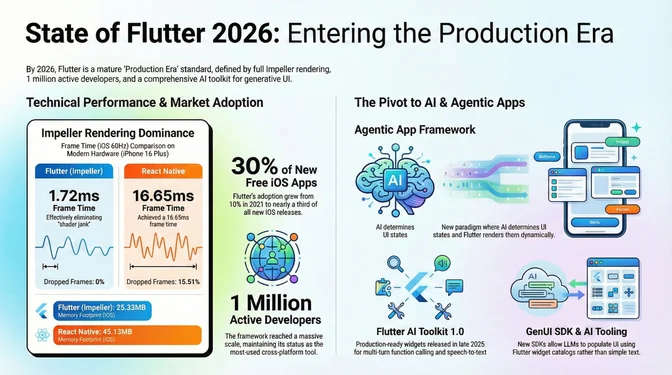
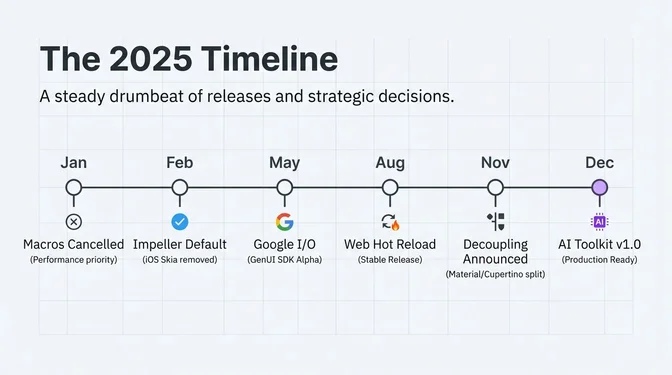
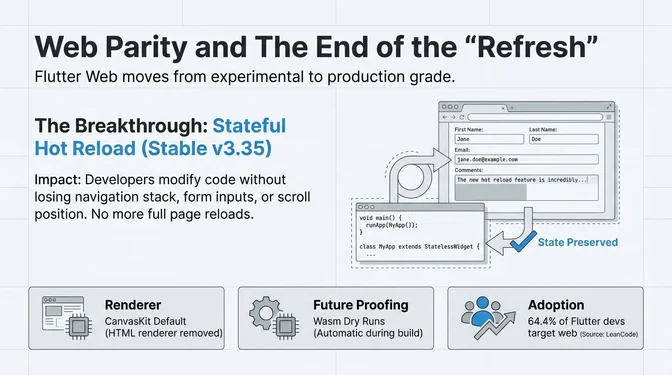
The tension between maturation and disruption defined Flutter's 2025. The Impeller transition locked in. iOS lost its Skia opt-out entirely, and Android API 29+ gained Impeller as default, eliminating the notorious shader compilation jank that plagued complex animations for years on those platforms. Skia remains on the web; on Android, API 29+ retains a deprecated manual opt-out to Skia, while devices below API 29 still default to Skia. Stateful hot reload arrived on web, bringing the web development loop into parity with mobile for the first time. With nearly 30% of new free iOS apps now built with Flutter, up from ~10% in 2021, the framework became the most-used cross-platform framework for the fourth consecutive year in JetBrains developer surveys, which measure which frameworks developers report actively using. With over one million developers actively using Flutter, the framework entered what Google calls its "Production Era".
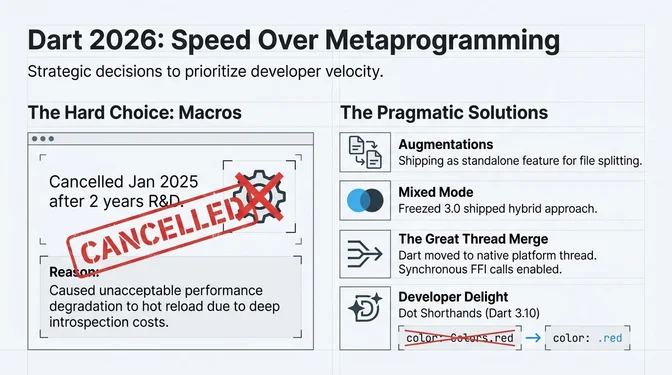
The Dart and Flutter teams shipped eight stable releases in 2025: four Flutter versions paired with four Dart versions on a quarterly cadence, showing continued investment despite the 2024 layoffs that affected approximately 200 employees from Core teams. The biggest technical pivot came in January when the Dart team stopped work on macros entirely, citing unacceptable performance degradation to hot reload after over two years of development. Freezed 3.0 shipped shortly after with a "mixed mode" approach, and the team committed to improving build_runner performance with 2× speedups in some scenarios. Dart 3.10 shipped dot shorthands syntax in November, letting developers write .center instead of MainAxisAlignment.center, adopting one of Swift's most beloved features.
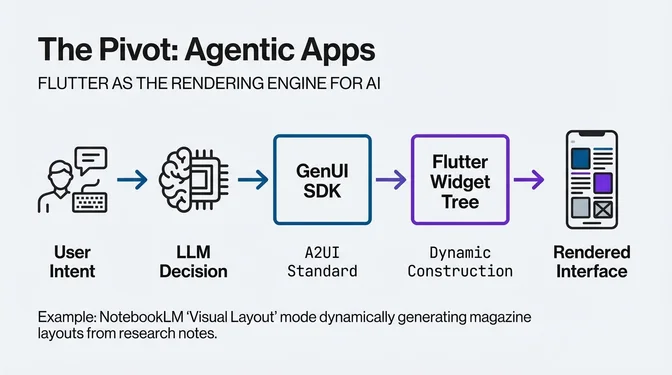
The AI pivot is Flutter's bid for relevance in an agentic future. Google I/O 2025 pitched Flutter as the framework for building "agentic apps", applications where AI determines the next UI state and Flutter renders it. The GenUI SDK launched in alpha, letting LLMs populate UI using Flutter widget catalogs rather than responding with text. The Flutter AI Toolkit reached v1.0 in December with pre-built chat widgets, multi-turn function calling, and speech-to-text support. Meanwhile, the Dart & Flutter MCP Server matured, letting AI assistants navigate codebases and handle multi-step refactors with deep project knowledge.
Actions for 2026: Migrate to Impeller if you haven't already. Flutter removed Skia from iOS. On Android, Impeller runs by default on API 29+ (Flutter 3.38 deprecated the opt-out), while Flutter web renderers still use Skia today. Prepare for the Material/Cupertino decoupling by auditing your widget dependencies. Explore the Flutter AI Toolkit for building AI-powered features.
Flutter 2025 Timeline
January 2025
Platform Adoption Statistics
Notable Commits Tracking Issue
Macros Cancellation
February 2025
Flutter 3.29 & Dart 3.7
HTML Renderer Removal on Web
Cupertino and Material Updates
Tall Style Formatter Controversy
Freezed 3.0
March 2025
Flutter Heroes Turin
April 2025
Flutter 2025 Roadmap Published
Flutter Connection Paris
May 2025
CVE-2025-27363 Added to CISA KEV
Flutter 3.32 & Dart 3.8 (Google I/O)
--web-experimental-hot-reload). Before this, "hot restarting" a web app meant losing current app state: navigation stack, form inputs, and scroll position. Stateful hot reload became the default in master channels, with developers able to try it right away in DartPad. The release introduced "Cupertino Squircles," the RSuperellipse shape matching Apple's native rounded corners, requiring deep changes in the rendering engine to support continuous curvature. Dart 3.8 introduced null-aware elements for collections, allowing conditional inclusion of elements with a ? prefix.LG Partnership
NotebookLM Launch
Widget Property Editor & DartPad AI
Major Adoption Announcements
FlutterNinjas Tokyo
June 2025
CVE-2025-1568 "GerriScary"
FlutterCon USA New York
July 2025
Job Market Snapshot
Stack Overflow Survey 2025
August 2025
Flutter 3.35 & Dart 3.9
@Preview annotations for visualizing widgets in isolation. Automatic Wasm dry runs during builds prepare codebases for a future where WebAssembly is the default.More 3.35 Features
Material/Cupertino Decoupling
Dart & Flutter MCP Server
1,108 Commits from 168 Contributors
Benchmark Study Published
Key Departures
September 2025
Shorebird CI Launch
FlutterCon Berlin
October 2025
Flutter Salary Data
GitHub Octoverse 2025
November 2025
Flutter 3.38 & Dart 3.10
.center instead of MainAxisAlignment.center. Build hooks became stable to integrate native build steps directly into Dart packages.Platform Updates
Accessibility & Desktop
Flutter Flight Plans
Jaspr Migration
Flutter 3.38.1 Hotfix
CompositedTransformFollower + OverlayEntry pattern for tooltips and dropdowns, breaking existing code in debug mode with no migration guide provided.GenUI SDK Alpha
CVE-2025-65112 PubNet Vulnerability
December 2025
Flutter AI Toolkit v1.0
Top Ten Highlights Blog Post
Enterprise Case Studies
Appfigures Year-End Analysis
The Impeller Transition
Impeller's mobile rollout is the biggest technical achievement in Flutter's history. For years, the Skia graphics engine compiled shaders on the fly (Just-In-Time) during the first run of an animation, causing dropped frames known as "shader compilation jank." The team designed Impeller to pre-compile a smaller, more specialized set of shaders at build time (Ahead-of-Time).
The impact proved measurable: 30-50% reduction in jank frames during complex animations, 20-40% improvement in text rendering, and real-world testing showing 12% dropped frames with Skia versus just 1.5% with Impeller. The primary metric of success is not higher average frame rates but the reduction in worst-case frame times, the 99th percentile that causes visible stutters.
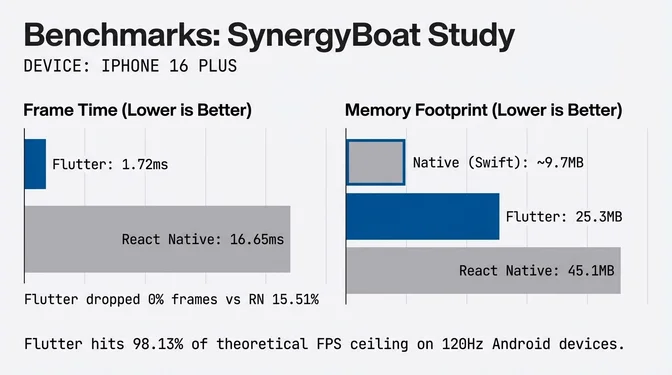
In the SynergyBoat benchmark, Flutter's memory footprint measured 25.33MB on iOS (iPhone 16 Plus) and 14MB on Android (Galaxy Z Fold 6), higher than native (9.74MB/6.33MB) but lower than React Native's 45.13MB/32.98MB.
Avalonia reported major power efficiency gains, leading to their partnership with Google to bring Impeller to .NET. Streamlined graphics context initialization improved app startup times.
The Vulkan Backend allows Impeller to target the Vulkan API for lower-level GPU control, managing memory and command buffers more efficiently. On API 29+ devices without functional Vulkan, Impeller uses its OpenGLES backend. Devices below API 29 fall back to Skia, with automatic detection at launch.
The Flock Fork and Community Tensions
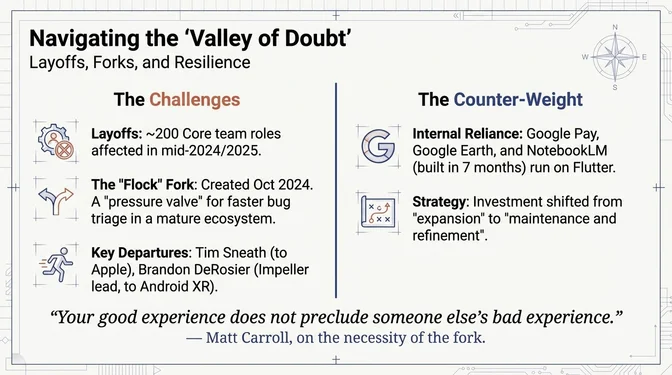
In October 2024, Matt Carroll, a former Google Flutter team member, announced Flock, a community fork of Flutter.
The project's stated grievances carried into 2025: an estimated 50 team members serving 1,000,000+ developers (a 1:20,000 ratio), slow PR review times, desktop platforms remaining "mostly stagnant," and serious bugs left unfixed.
The community response split sharply. Critics called it "a complete waste of time" while supporters validated frustrations, particularly developers with enterprise experience dealing with slow issue resolution. Google responded by noting developers have forked Flutter "thousands of times" as normal open source practice.
In 2025, the fork served less as a competitor and more as a pressure valve. It highlighted areas where official triage was too slow, often prompting the upstream team to address long-standing issues.
Carroll emphasized: "Your good experience does not preclude someone else's bad experience."
The fork's existence signals community resilience rather than decline: developers invested enough to build alternatives rather than simply leaving.
AI Integration Strategy
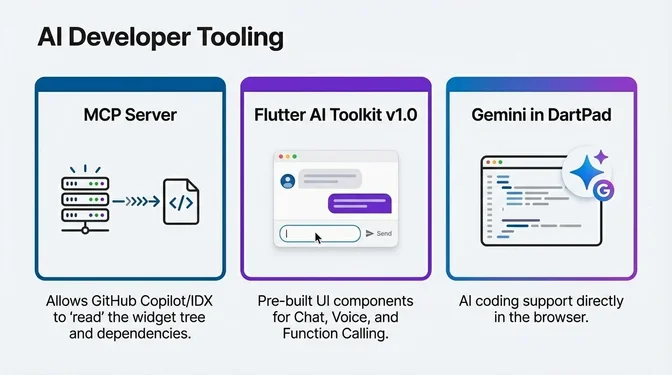
Google I/O 2025 pitched Flutter as the framework for building "agentic apps", applications where AI determines the next UI state and Flutter renders it. The Flutter Extension for Gemini CLI combined official Dart/Flutter rules with MCP tools for accelerated development.
The AI integration strategy includes: the Dart & Flutter MCP Server for AI assistants to understand Flutter context; Flutter AI Toolkit v1.0 with pre-made AI-driven widgets for text and image generation; the GenUI SDK for LLM-driven UI generation; Antigravity, a prototype AI IDE layer that can convert natural language to Flutter code, refactor layouts, and migrate projects between frameworks; and the Firebase AI Logic SDK (formerly firebase_vertexai) for direct Gemini model integration.
The Android Studio Meerkat Feature Drop brought first-class Gemini code completion for Dart/Flutter out of the box, while the Gemini Code Assist extension added AI support to VS Code and IntelliJ. The Flutter AI Playground demonstrated multimodal generative AI features including text, image generation, and chat interfaces.
Flutter 2026 Watchlist
1. Flutter 4.0
When: Speculated for mid-2026
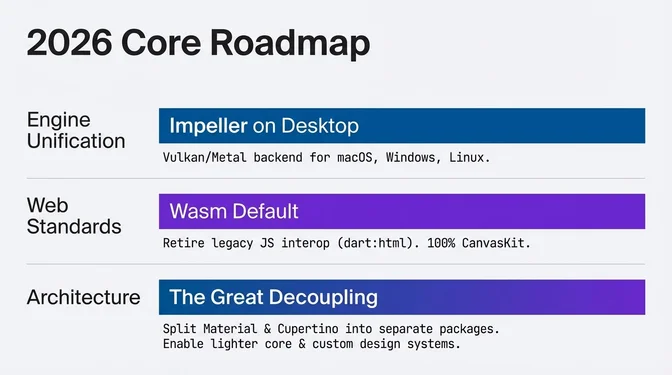
Context: Flutter 4.0 may arrive once the team achieves core goals like design decoupling, though the official roadmap makes no version promises. The roadmap commits to four stable and twelve beta releases and states they're not investing in built-in code push. Look for Flutter 3.41 & Dart 3.11 (February 2026), which should include final pieces of the 2025 roadmap. Expected features: smaller core modules, next-phase Impeller optimizations, enhanced Material Design 3 integration, better desktop support with native-like UI elements, and further app size reductions via modularization. It would be Flutter's first major version bump since 2022.
Action: Follow the Flutter roadmap on GitHub and prepare for potential migration steps.
2. Material/Cupertino Decoupling
When: Q2 2026 (likely)
Context: The Material/Cupertino split will likely ship in 2026. When it happens, developers may need to update imports (e.g., add a dependency for the Material package), but Flutter will provide migration tools and grace periods. By decoupling, Flutter opens the door for third-party design frameworks. Expect packages for Fluent UI (Windows design) or community-driven Material Design alternatives.
Action: Audit your widget dependencies now to understand which design libraries you use.
3. WebAssembly Default
When: 2026
Context: WebAssembly is on track to become the default for Flutter Web output. The team has been preparing with Wasm dry-runs in 3.35+ builds. WebAssembly compilation delivered 40% faster load times and 30% less runtime memory in tests. The combination of Wasm and multi-threaded rendering (SharedArrayBuffer) has improved frame rates in the browser. The team is retiring legacy JS interop (dart:html, package:js); developers should migrate to the new Wasm-safe interop model. The Flutter web team is also working on JS interop improvements and bringing CanvasKit improvements to older devices.
Action: Run Wasm dry runs on your web projects now and migrate away from legacy JS interop.
4. LG webOS SDK
When: H1 2026
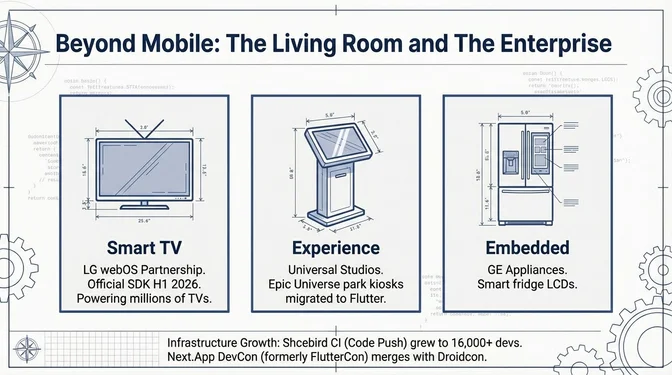
Context: LG's partnership targets H1 2026 release of an official Flutter SDK for webOS TVs, allowing Flutter developers to deploy apps to millions of LG smart TVs. LG Electronics is adopting Flutter for global webOS TV applications.
Action: If you build consumer apps, start planning TV-optimized layouts with 10-foot UI principles.
5. Impeller Desktop Expansion
When: Ongoing through 2026
Context: With Impeller now default on both mobile platforms, 2026 will likely see it expanding to Desktop (macOS/Windows/Linux). The team is actively working on an Impeller Vulkan backend for Linux and Metal for macOS. The goal is a single, unified rendering engine across all six platforms, eliminating Skia maintenance burden. The next phase of optimization will likely focus on 3D capabilities and compute shaders.
Action: Test your desktop apps with Impeller preview flags when available.
6. Augmentations
When: 2026
Context: Augmentations shipping independently, what remains of the macros effort, will allow splitting class definitions across files as a standalone feature. With macros cancelled, this represents the remaining path forward for Dart metaprogramming.
Action: Watch for augmentations in upcoming Dart releases and see how they can simplify your code generation.
7. Swift Package Manager Default
When: 2026
Context: The official roadmap commits to Swift Package Manager becoming the default iOS plugin option.
This includes experimental direct calls from Dart to Swift/Objective-C and Java/Kotlin without platform channels.
Action: Start migrating iOS plugins to Swift Package Manager format.
8. Platform Parity Mission
When: Ongoing through 2026
Context: The stated goal for 2026 is Platform Parity, erasing the "uncanny valley" where a Flutter app feels close to native but falls short. Flutter will need to adapt to iOS 26 (Apple switched to year-based versioning at WWDC 2025, skipping from iOS 18 to iOS 26) and Android 17 ("Cinnamon Bun"), both expected around June 2026. Flutter's ongoing platform parity work includes supporting the 16KB page sizes introduced with Android 15's targeting mandate. Google is likely to keep Flutter day-and-date with new OS betas as they did in 2025. Expect deeper integration with system accessibility APIs, better support for foldable devices, and desktop-class window management as standard.
Action: Test your apps on foldables and multi-window desktop configurations.
9. Next.App DevCon (formerly FlutterCon Berlin)
When: October 7-9, 2026
Context: FlutterCon Berlin announced it will merge with Droidcon and other ecosystem events to become Next.App DevCon in 2026. It aims to be the world's largest mobile developer conference. Other dates to mark: Google I/O 2026 (expected May), FlutterCon USA 2026 in Orlando (late Q3), Flutter Vikings return in-person (August 2026).
Action: Block October 7-9 for Next.App DevCon in Berlin.
10. GenUI SDK Production
When: 2026
Context: Given the AI push, 2026 will likely bring the GenUI SDK out of alpha into beta/production. The Flutter AI Toolkit will expand with more widgets. Google's "Antigravity" AI IDE could evolve into a public preview. The Model Context Protocol (MCP) might become a standard for IDEs and CI tools to communicate with AI agents. Plugins for VS Code using MCP to auto-fix Flutter analysis issues are possible. On traditional tooling, Flutter DevTools will get a revamp with a unified "Inspector 2.0" UI. Build times should drop further as the Dart team continues to optimize build_runner and code generation. Startup latency may also improve as Dart's AOT engine gains profile-guided optimizations or smaller precompiled runtime kernels.
Action: Experiment with GenUI SDK and the Flutter AI Toolkit in non-production projects.
11. Next Major Dart Release
When: No announced timeline
Context: With macros cancelled, there's pressure for a native solution for data classes (immutability, equality, copyWith) without code generation. Continued improvements in "Native Assets" will make calling C, Rust, or Swift code easier.
Action: Continue using build_runner and Freezed for now; test augmentations when available.
12. Kotlin Multiplatform Competition
When: Ongoing
Context: In Appfigures' year-end analysis, Kotlin Multiplatform accounted for 14% of downloads and 27% of revenue among cross-platform apps, thanks to a few high-earning KMP apps. With Kotlin Multiplatform reaching production-ready status, 2026 could see increased competition. Flutter will likely differentiate with its superior iOS fidelity and web support. If Compose Multiplatform gains traction, Flutter will continue to differentiate with its consistent UI rendering across platforms, whereas KMP shares logic but relies on native platform UI components.
Action: Understand KMP's strengths and position Flutter projects accordingly.
13. Deprecated API Removal
When: 2026
Context: Dart 3.10's new @Deprecated enhancements and lint rules make it easier to drop old APIs in a controlled way with clear migration guides. Older Material 2 style constants and widgets that Material 3 replaced long ago might get pruned in a 2026 release.
Action: Run deprecation analysis on your projects and migrate away from deprecated APIs.
14. Fuchsia OS Support
When: TBD
Context: Google's Pixel team has been collaborating to make Flutter a first-class citizen on Fuchsia OS. Any news of Flutter officially supporting Fuchsia in 2026 would be notable.
Action: Watch Flutter announcements for Fuchsia-related updates.
15. Flutter Favorites Program Expansion
When: Ongoing
Context: More packages (including Rust integration libraries, advanced graph/chart libraries, etc.) will likely earn Flutter Favorite status as Flutter usage diversifies into new domains. Mandatory 2FA is now enforced for Flutter Favorites packages.
Action: Review Flutter Favorites packages for your projects and consider contributing packages that could achieve Favorite status.
16. Stack Overflow Survey 2026
When: Mid-2026
Context: Will show if Flutter converted more "want to learn" developers and possibly surpassed React Native in usage. With strong developer retention in 2025, Flutter is in a good spot.
Action: Fill out the survey to help the Flutter community.
17. Flutter Foundation Discussions
When: Ongoing
Context: Discussions about forming a Flutter Foundation continued throughout 2025 as non-Google contributors began outnumbering Google developers. This could formalize community governance.
Action: Follow community discussions about Flutter governance if you're a major contributor.
18. Arduino & Raspberry Pi Community Support
When: Ongoing
Context: Community chatter about Arduino and Raspberry Pi getting better Flutter support continued, building on early work by community projects in 2025.
Action: Explore community projects for embedded Flutter development if targeting IoT devices.