State of Java 2026
JDK 25 arrived as the new LTS baseline alongside major platform convergence. The ecosystem's biggest pillars (Spring Boot 4/Spring Framework 7, Jakarta EE 11, and the tooling stack) aligned around modern Java (JDK 21+) and production-grade Loom. At the same time, Leyden's early ahead-of-time (AOT) work plus runtime shifts like compact object headers and generational Shenandoah changed the cost profile of services (startup, memory, and operational headroom), making Java more competitive in containers and serverless. And with Spring AI, LangChain4j, and Model Context Protocol (MCP)-enabled frameworks bringing first-class large language model (LLM) integration to the JVM, 2025 set up 2026 as the year this convergence turns into broad adoption across platform, productivity, and agentic systems.
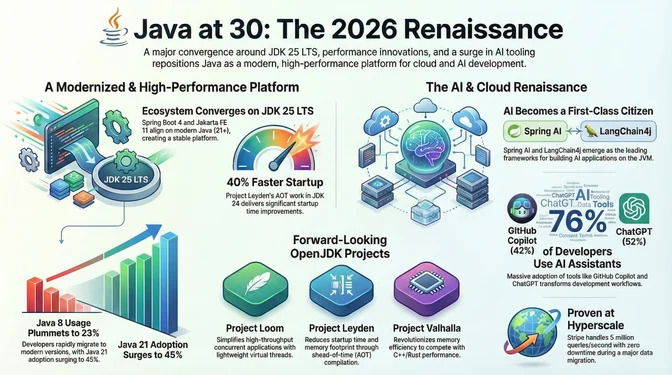
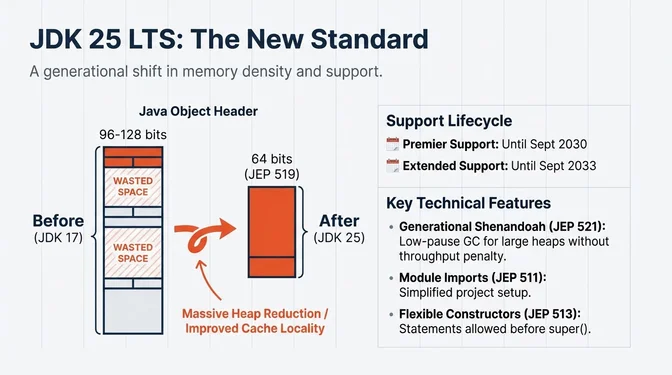
2025 then delivered the receipts: JDK 25 became the next LTS baseline (Premier Support through at least September 2030 and Extended Support through at least September 2033), with Oracle planning NFTC updates through September 2028 and OTN-licensed updates through at least September 2033.
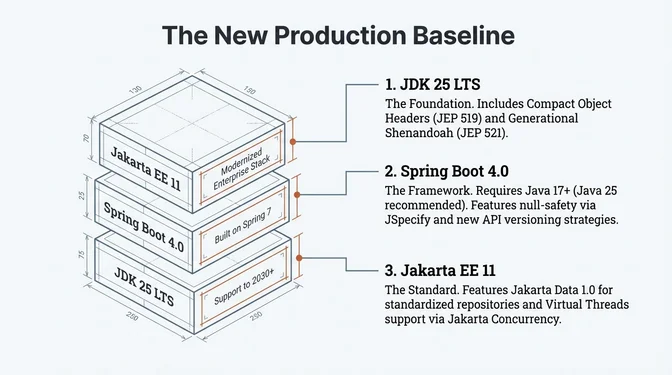
Spring Boot 4.0 rebuilt on Spring Framework 7.0, Jakarta EE 11 modernized the enterprise stack, and Loom's virtual threads crossed from "promising" to "normal" with Netflix publishing a production case study.
JDK 24 shipped Leyden's first practical AOT wins (40% faster startup for Spring PetClinic), while JDK 25 finalized Module Import Declarations, Compact Object Headers delivering significant heap reduction benefits, and Generational Shenandoah GC, shifting Java's startup/memory/ops curve.
Contrary to persistent "Java is dead" narratives, Azul's State of Java 2025 Report showed Java 8 usage plummeted to 23% from 40% in 2023, while Java 21 adoption surged to 45% according to Perforce's JRebel report. Approximately 76% of developers now use AI coding assistants with GitHub Copilot (42%) and ChatGPT (52%) leading usage. The year saw Oracle's controversial GraalVM pivot away from Java, positioning Project Leyden as the unified AOT strategy. JavaOne 2025 returned as a 3-day event celebrating Java's 30th anniversary, while Devoxx Belgium 2025 drew 3,038 unique attendees for the intellectual center of the ecosystem. Security remained critical with CVE-2025-53066 (CVSS 7.5) in JAXP and Spring's CVE-2025-41248 (Spring Security) and CVE-2025-41249 (Spring Framework) requiring prompt patching (especially for applications using @EnableMethodSecurity with generic type hierarchies).
The AI battleground intensified as Spring AI 1.0 GA and LangChain4j competed for the JVM AI framework crown, while Micronaut 4.10 and Helidon 4.3 adopted Model Context Protocol for LLM integration. Project Valhalla re-incubated value classes targeting JDK 26-27, promising to revolutionize memory density and compete with C++/Rust efficiency. Real-world validation came from Airbnb's Bazel migration achieving 3-5x faster builds with CSAT improving from 38% to 68%, and Stripe's zero-downtime data migrations handling 5 million queries/second. The ecosystem emerged with Java positioned not just as a legacy maintainer, but as a high-performance, memory-safe runtime for the agentic era. At 30 years old, Java has "the energy of a 20-year-old and the wisdom of a 40-year-old."
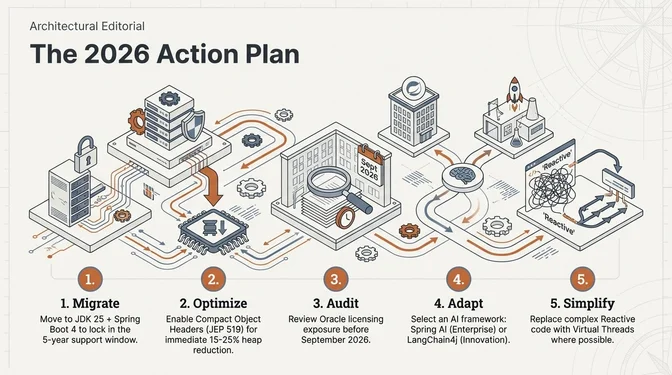
Actions for 2026: Migrate to JDK 25 LTS before Oracle's NFTC licensing for JDK 21 ends in September 2026. Upgrade to Spring Boot 4.0 for Jakarta EE 11 alignment. Complete Jakarta EE 11 migration (javax._ to jakarta._). Test Spring AI or LangChain4j for LLM integration. Patch CVE-2025-41248 and CVE-2025-41249 in Spring applications.
Java 2025 Timeline
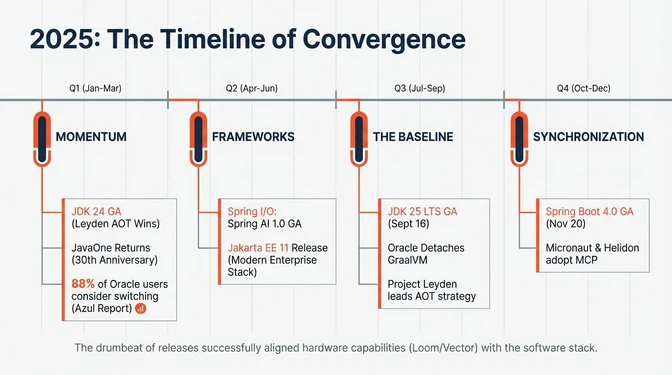
January 2025
Quarkus 3.17.6
Spring Cloud 2023.0.5
Micronaut 4.7.4
Oracle's Critical Patch Update
jChampions Conference
Azul's State of Java 2025 Report
March 2025
Helidon 4.2
JavaOne 2025
JDK 24 GA
April 2025
Oracle's Critical Patch Update
Spring Security Advisory
BCryptPasswordEncoder.matches() incorrectly returned true for passwords exceeding 72 characters.May 2025
Spring I/O 2025
Spring Boot 3.5.0
@ServletRegistration/@FilterRegistration annotations, environment variable properties with env: prefix, SSL support for Cassandra/Couchbase/Elasticsearch/Kafka/MongoDB/RabbitMQ/Redis, and bean background initialization for faster startup.June 2025
Jakarta EE 11
July 2025
Oracle's Critical Patch Update
Gradle 9.0.0
August 2025
Eclipse Temurin and IntelliJ IDEA
Spring Framework CVE-2025-41242
September 2025
GraalVM Detachment
Spring Security Fixes
JDK 25 LTS GA
public static void main boilerplate, and JEP 513 (Flexible Constructor Bodies) allowing statements before super(). JEP 519/450 (Compact Object Headers) promoted to production delivering significant heap reduction and performance benefits from compressing object headers from 96-128 bits to 64 bits. JEP 521 (Generational Shenandoah) reached production-ready status. Project Leyden expanded with JEP 514 (AOT Command-Line Ergonomics) and JEP 515 (AOT Method Profiling) with example programs showing ~15-25% faster startup vs JDK 24 when trained. JEP 520 (JFR Method Timing) democratized profiling.Amazon Corretto 25 and Vendor Releases
October 2025
Helidon 4.3.0
Devoxx Belgium 2025
Oracle's Critical Patch Update
Micronaut Framework 4.10.0
Gradle 9.2.0 and Quarkus 3.27
November 2025
Spring Boot 4.0.0 GA
December 2025
JakartaOne Livestream 2025
IntelliJ IDEA 2025.3
Java Platform Extension for VS Code 25.0.0
Developer Productivity and Industry Statistics
AI Adoption: Approximately 76% of Java developers use AI coding assistants (12% don't use, 12% prohibited) with GitHub Copilot (42%) and ChatGPT (52%) leading usage according to Perforce's JRebel report. JetBrains State of Developer Ecosystem 2025 confirmed 85% of developers use AI tools in some capacity, with Java used by 29% in past year.
Hiring and Budgets: Perforce JRebel 2025 Report revealed 51% of companies planned to add Java developers (down from 60% in 2024), 34% planned to increase budgets for developer tools, and 70% of Java teams used remote or containerized dev setups introducing longer redeploy times.
Language Rankings: TIOBE Index showed Java declining from 10.15% (January) to 8.35% (October), landing at fourth place as C# surged past Java for first time in years. Stack Overflow Developer Survey 2025 showed approximately 30% of professional developers use Java, ranking among top 6 languages.
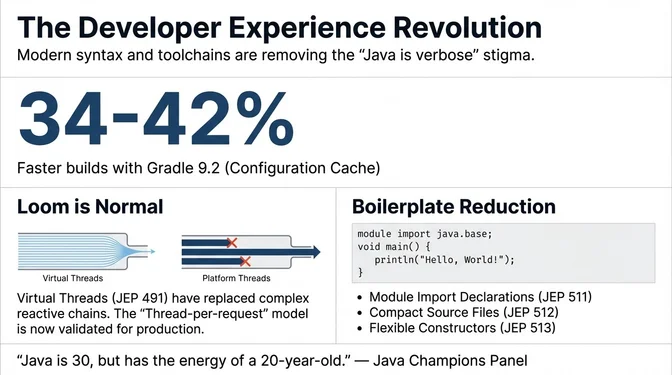
Virtual Threads vs Reactive Debate Resolved: With Project Loom's virtual threads production-ready (JDK 21+), 2025 saw industry settle the debate: simple thread-per-request models can replace complex reactive frameworks for many use cases. Spring Framework 6 & 7 incorporated virtual thread support, while reactive streams keep advantages for certain high-throughput streaming logic. Jetty and Tomcat experiments with Loom validated virtual threads simplifying concurrency by 2026.
Container, Kubernetes, and Serverless Innovation
Java Operator SDK 5.0 GA (January 6, 2025) simplified building Kubernetes Operators in Java with first-class Kubernetes Server-Side Apply support and improved event source abstractions. Eclipse Adoptium offered JDK 21/25 base images with small footprints, while tools like Jib and Buildpacks updated immediately for new JDK versions.
Project CRaC (Coordinated Restore at Checkpoint) enables JVM snapshotting for instant startup under OpenJDK. Early builds with JDK 21 showed startup times in tens of milliseconds, addressing Java's cold start in FaaS (Functions-as-a-Service). Helidon 4.2 added CRaC support for instant microservices startup. Microsoft published guidance on accelerating Java applications on Azure Kubernetes Service with CRaC.
GPU Acceleration: TornadoVM 2.0 GA (late 2025) brought experimental support for accelerating Java on GPUs and FPGAs, opening possibilities for compute-intensive AI workloads beyond CPU-only execution.
AI Frameworks: The Battle for JVM AI Supremacy
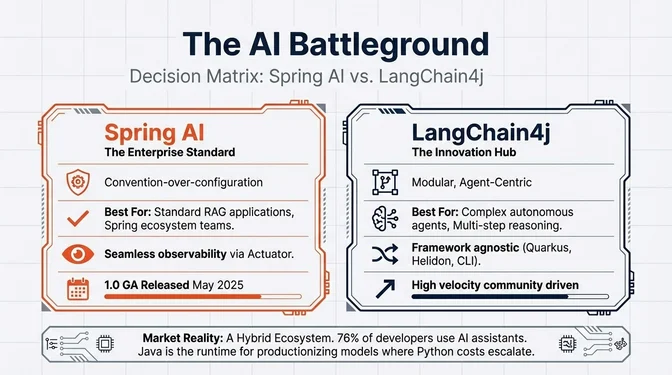
The year saw fierce competition between Spring AI and LangChain4j for the JVM AI framework crown. Spring AI vs Langchain4j comparison highlighted divergent philosophies:
Spring AI (Convention-Over-Configuration):
- Spring I/O 2025 GA announcement validated enterprise adoption
- Declarative, template-based developer experience (Spring Data familiarity)
- Deep Spring Boot Actuator observability integration
- Default choice for enterprises in Spring ecosystem
- Excels at standard RAG applications with seamless security
LangChain4j (Modular Java-First):
- Framework-agnostic running in standalone apps, CLI tools, Quarkus, Helidon
- More mature Agent abstractions for multi-step reasoning
- Gained traction among innovation teams building autonomous agents
- Granular control for complex agentic workflows
The Verdict: DevFest Toulouse 2025 "Codepocalypse Now" session revealed a hybrid pattern: large enterprises use Spring AI for standard RAG, while innovation teams favor LangChain4j for autonomous agents. Healthy competition drove rapid improvement across both frameworks.
Real-World Adoption at Hyperscale
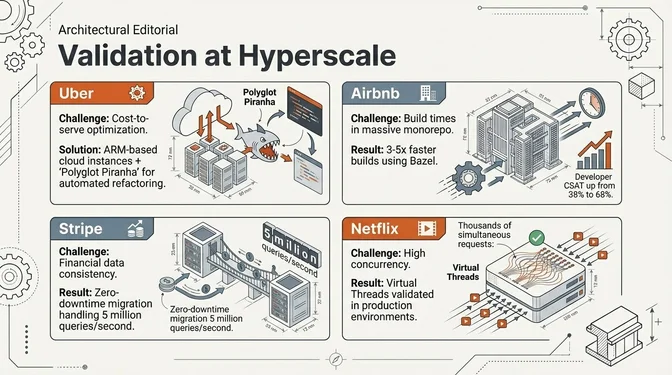
Netflix: Virtual Threads in Production
Netflix published a production case study on virtual-thread performance and pitfalls exploring Project Loom adoption in Java 21 + Spring Boot. The study documented production challenges with pinning and locking while demonstrating promising performance characteristics. How Netflix Really Uses Java provided conference validation that virtual threads are production-ready for conservative enterprises willing to address known pitfalls.
Uber: Automated Refactoring at Scale
Uber's strategy for upgrading 2M+ Spark jobs utilized "Polyglot Piranha" tool for automated refactoring, treating migration as software engineering problem. Uber embraced ARM-based cloud instances for Java workloads optimizing cost-to-serve ratios, highlighting JVM's cross-platform strengths.
Airbnb: Bazel Monorepo Transformation
Airbnb's JVM monorepo migration to Bazel achieved 3-5x faster local builds with developer CSAT improving from 38% to 68%. The case study showed that at massive repository scales, hermetic build systems like Bazel become necessary for developer velocity.
Stripe: Zero-Downtime Financial Engineering
Stripe's DocDB platform upgrades handled 5 million database queries/second migrating tens of terabytes of financial data with zero downtime, reinforcing Java's dominance in fintech where teams cannot sacrifice consistency for speed.
OpenJDK Projects Roadmap
| Project | Status | Target | Impact |
|---|---|---|---|
| Project Loom | Production (JDK 21+) | Structured Concurrency JDK 26-27 | Virtual threads simplify concurrency in many use cases, Scoped Values finalized |
| Project Leyden | Active (JDK 24-25) | Full AOT JDK 27-28 | ~40% faster PetClinic startup; 15-25% faster for example programs with trained AOT caches (JDK 25 vs JDK 24), Oracle's GraalVM replacement strategy |
| Project Valhalla | Re-incubated | Preview JDK 26-27 | Value classes enabling 20-40% memory reduction, compete with C++/Rust efficiency |
| Project Panama | FFM API finalized | Vector API ongoing | Native interoperability (C/C++/Rust), SIMD parallelism for AI workloads |
| Project Amber | JDK 25 finalized | String Templates JDK 26 | Module Imports, Compact Source, Flexible Constructors shipped |
| Project Babylon | Research | Early JEPs TBD | Code reflection for SQL DSLs, ML models |
Java 2026 Watchlist
1. JDK 26 and 27 Features
When: JDK 26 GA March 2026, JDK 27 September 2026
Context: JDK 26 entered Rampdown Phase One in late 2025. Expected features include String Templates finalized, Structured Concurrency (Sixth Preview), Lazy Constants (Second Preview), Vector API (Eleventh Incubator), and JEP 500 (Prepare to Make Final Mean Final) restricting reflection loopholes. Oracle formed JSR Expert Group for Java 27 indicating significant features under JCP review.
Action: Test JDK 26 early access builds for compatibility. Plan migration from JDK 21 to 25 before September 2026 when Oracle's permissive licensing (NFTC) for JDK 21 ends. Track Project Valhalla for possible first preview of value classes in JDK 26-27.
2. Project Valhalla Production Delivery
When: Likely JDK 27-28 (late 2026-2027)
Context: Re-incubation of Value Classes (JEP 401) in late 2025 signals nearing finality. Try the New Valhalla EA Build shows active development. By enabling "flat" memory layouts for objects, Valhalla promises to revolutionize Java's performance in AI and data-heavy applications, allowing Java to compete with C++ and Rust in memory efficiency while retaining memory safety.
Action: Download Valhalla EA builds for testing with data-intensive workloads. Identify memory-heavy applications (collections, arrays, numerical computing) for 20-40% heap reduction potential. Plan generic specialization strategies for performance-critical code.
3. Jakarta EE 12 and MicroProfile 8
When: Jakarta EE 12 targeting July 2026 GA with JDK 21+
Context: Jakarta EE 12 will focus on consistency and configuration. With Jakarta EE 11 freshly out, vendors will release compliant servers: Red Hat's WildFly, IBM's WebSphere Liberty/Open Liberty, Apache TomEE. MicroProfile 8.0 could arrive late 2026 aligning with Jakarta EE 11 and JDK 21+ for cloud-native Java APIs.
Action: Complete Jakarta EE 11 migration (javax._ to jakarta._) by mid-2026. Track Jakarta EE 12 specifications for cloud features and GraalVM native image compatibility. Test MicroProfile 8.0 early access for cloud-native API evolution.
4. Spring Ecosystem Evolution
When: Spring Framework 7.1/7.2 throughout 2026, Spring 8 planning by year-end
Context: Spring Boot 4.x enters widespread use in 2026 as organizations migrate to Java 21+ era. Spring might begin revealing Spring 8 plans targeting Java 25 or 29 baseline. Project Reactor and Spring WebFlux will adapt in Loom world, possibly simplifying programming model thanks to virtual threads. Given GraalVM's shift, Spring may lean on OpenJDK's Project Leyden for native compilation rather than GraalVM Native Image.
Action: Migrate to Spring Boot 4.0 for Jakarta EE 11 alignment and null-safety. Test virtual threads as replacement for WebFlux reactive stacks. Review Project Leyden integration for AOT compilation replacing GraalVM Native Image.
5. GraalVM and Project Leyden Convergence
When: Project Leyden preview JDK 27-28 (2026-2027), GraalVM 26-27 community releases
Context: Oracle detached GraalVM from Java with GraalVM for JDK 24 as final Oracle release. Project Leyden will deliver first fruits, perhaps an early preview of Java static image tool integrated with JDK. Community-driven GraalVM Community Edition continues with Red Hat's Mandrel providing timely native-image builds (Mandrel 26, 27) for Quarkus users.
Action: Track Project Leyden JDK 27-28 prototypes for AOT compilation validation. For Quarkus/native-image users, track Red Hat Mandrel releases for JDK 26-27 support. Test GraalPython/GraalJS polyglot improvements for non-Java workloads.
6. Virtual Threads Production Adoption
When: Mainstream adoption throughout 2026
Context: With Project Loom's virtual threads production-ready in JDK 21+, 2025 saw industry adopt virtual threads for simpler concurrency. Netflix published a production case study on virtual-thread performance and pitfalls (pinning/locking issues in Java 21 + Spring Boot), providing valuable lessons for early adopters. Spring Framework 6 & 7 incorporated virtual thread support, while Akka blends Loom into actor model for "best of both" approach. Java web frameworks (Jetty, Tomcat) embrace virtual threads simplifying concurrency.
Action: Review virtual threads for simpler concurrency in thread-per-request models. Enable virtual threads in Spring Boot 4.0 and Jakarta EE 11 servers. Study Netflix's production lessons on pinning/locking before migrating from reactive stacks. Benchmark throughput/scalability vs reactive programming for your workload.
7. AI Tooling and Agentic Java
When: Continuous throughout 2026
Context: Approximately 76% of Java developers use AI coding assistants with GitHub Copilot (42%) and ChatGPT (52%) leading according to Perforce's JRebel report. The "Agentic" shift moves from chatbot integrations to autonomous AI agents. Microsoft 2025 Year in Review highlighted Semantic Kernel for Java, Spring AI integrations, and GitHub Copilot App Modernization using agents to automatically upgrade frameworks and refactor legacy codebases.
Action: Deploy Spring AI or LangChain4j for RAG applications (~76% of teams already use AI assistants). Add GitHub Copilot for framework upgrades and legacy code refactoring. Review Model Context Protocol (MCP) integration in Micronaut 4.10+ and Helidon 4.3+ for LLM connectivity.
8. Oracle Licensing Migration
When: Deadline September 2026 (JDK 21 permissive licensing/NFTC ends)
Context: Oracle's "Java SE Universal Subscription" charges based on total employee count rather than Java users. Azul 2025 State of Java Survey revealed **88% of Oracle Java users considering switching** to alternative JDK providers like Azul Zulu, Amazon Corretto, Eclipse Temurin, Microsoft OpenJDK. This exodus democratized the runtime market and weakened Oracle's commercial grip.
Action: Complete migration from Oracle JDK to Eclipse Temurin, Amazon Corretto, or Azul Zulu before September 2026. Audit licensing costs under employee-based model. Test production workloads on alternative JDK distributions.
9. Java in Containers and Kubernetes
When: Continuous evolution throughout 2026
Context: Java Operator SDK hit 5.0 GA on January 6, 2025, simplifying building Kubernetes Operators in Java with first-class Kubernetes Server-Side Apply support. Eclipse Adoptium offers JDK base images for Java 21 and 25 with small footprints. Tools like Jib and Buildpacks updated for new JDK versions. Project CRaC (Coordinated Restore at Checkpoint) enables JVM snapshotting for instant startup; early builds with JDK 21 showed startup in tens of milliseconds, addressing Java's cold start in FaaS.
Action: Adopt Java Operator SDK 5.0+ for Kubernetes Operators in Java. Test Eclipse Temurin JDK 21/25 base images for container optimization. Review Project CRaC for serverless/FaaS workloads requiring sub-second cold start.
10. Security and Quantum-Resistant Cryptography
When: Finalization in JDK 26-27
Context: Java 24/25 introduced quantum-resistant cryptography with JEP 496/497 (ML-KEM, ML-DSA algorithms). Expect JDK 26/27 to finish PQC algorithms ensuring Java remains secure for next decade. 2025 saw critical vulnerabilities: CVE-2024-56171 (CVSS 9.8), CVE-2025-53066 (CVSS 7.5), and Spring's CVE-2025-41248 (Spring Security) and CVE-2025-41249 (Spring Framework).
Action: Enable quantum-resistant cryptography for long-lifecycle government/financial systems. Track Oracle Critical Patch Updates quarterly (January, April, July, October). Subscribe to Spring Security advisories for immediate patching. Audit JNI/native access usage before a future JDK flips the default from warnings to blocking (JEP 472).
11. Build Tool Performance Revolution
When: Gradle 9.x adoption throughout 2026, Maven 4 arrival
Context: Gradle 9.2.0 achieved 34-42% faster builds with 7-12% memory reduction, Windows ARM64 support. Airbnb's Bazel migration achieved 3-5x faster local builds. Maven 4 development continues with community excitement building.
Action: Migrate to Gradle 9.x for configuration cache and 34-42% faster builds. Test Maven 4 early access for large repositories. Review Bazel for massive monorepos (50k+ files) hitting Gradle/Maven ceilings.
12. JVM Language Evolution
When: Kotlin 2.3/2.4 (2026), Scala 3.9 LTS (Q2 2026), Clojure 1.13
Context: Kotlin 2.3 planned spring 2026, 2.4 mid-year finalizing multiplatform story and optimizing K2 compiler. Scala 3.9 LTS anticipated Q2 2026, a big event for community enabling Scala 2.13 to 3.9 LTS migration. Clojure might release 1.13 if Rich Hickey has feature set ready.
Action: Plan Kotlin 2.3/2.4 migration for multiplatform projects. Review Scala 3.9 LTS for Scala 2.13 migration strategy. Track Clojure 1.13 for functional programming updates.
13. JavaOne 2026 and Ecosystem Events
When: JavaOne March 17-19, 2026; Devoxx France April 22-24, 2026
Context: JavaOne 2026 announced for March 17-19, 2026 at Oracle headquarters coinciding with JDK 26 GA. Event will dive into Java 29 (next LTS) roadmap and Valhalla/Loom progress. Devoxx France 2026 runs April 22-24 with Devnexus, other Devoxx editions continuing. 2026 might mark 20th anniversary of first Java Champion awards.
Action: Submit JavaOne 2026 sessions on JDK 25/26 migration strategies. Attend Devoxx France 2026 for ecosystem updates. Join Java Champions 20th anniversary celebrations.
14. Java in AI and Data Science Workloads
When: Growing niche throughout 2026
Context: While Python dominates AI/ML development, Java found its niche productionizing AI models where Python prototypes hit operational cost walls. Libraries like DJL (Deep Java Library) and DeepLearning4J saw active development. TornadoVM 2.0 GA brought experimental GPU/FPGA acceleration for Java workloads.
Action: Review DJL (Deep Java Library) for productionizing AI models at scale. Test DeepLearning4J for on-premise ML workloads. Experiment with TornadoVM 2.0 for GPU-accelerated compute-intensive AI applications. Position Java as type-safe, reliable runtime for agentic systems vs Python prototypes.
15. WebAssembly and Edge Computing
When: Exploratory throughout 2026
Context: Topics like server-side WebAssembly (running Java bytecode in Wasm via TeaVM or WASI experiments) gained attention at Devoxx Belgium 2025. Project Wasm in OpenJDK (exploratory) might surface, compiling Java bytecode to WebAssembly is niche but intriguing, widening Java's deployment options to include client-side WebAssembly modules and edge computing environments.
Action: Track OpenJDK Project Wasm for Java-to-WebAssembly compilation progress. Test TeaVM for client-side WebAssembly modules. Review WASI experiments for edge computing deployments.
16. Compact Object Headers and Memory Optimization
When: Production use throughout 2026 (JDK 25+)
Context: JEP 519/450 (Compact Object Headers) promoted to production in JDK 25. Oracle's announcement highlights significant heap reduction and performance benefits due to improved CPU cache locality from compressing object headers from 96-128 bits to 64 bits. For cloud-native architectures running thousands of microservices, this translates directly to smaller container sizes and reduced AWS/Azure bills.
Action: Enable Compact Object Headers in JDK 25 production deployments. Measure heap usage reduction (target 15-25%) and execution speed improvement (target 5-10%). Calculate cloud cost savings from smaller container sizes. Combine with Project Leyden AOT for peak startup/memory optimization.