State of Kotlin 2026
Kotlin reached 2.5 million developers worldwide in 2025, defined by three converging vectors: K2 mode becoming the default for IntelliJ IDEA code analysis alongside JetBrains-reported 40%+ compilation time reductions in its IntelliJ monorepo, Compose Multiplatform for iOS reaching stable with 96% of teams reporting no major performance concerns, and an aggressive pivot toward AI-native development with Koog (open-source agent framework) and Mellum (JetBrains code LLM with a Kotlin-fine-tuned variant).
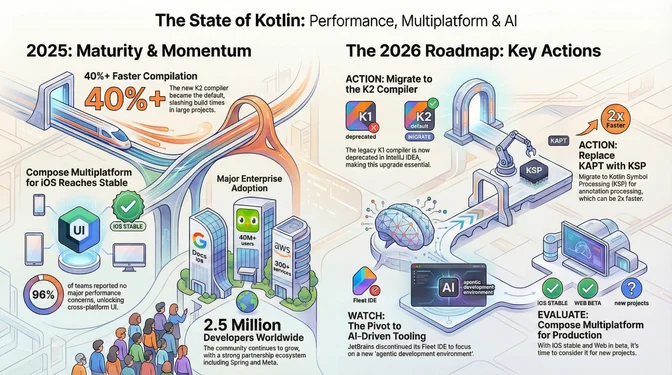
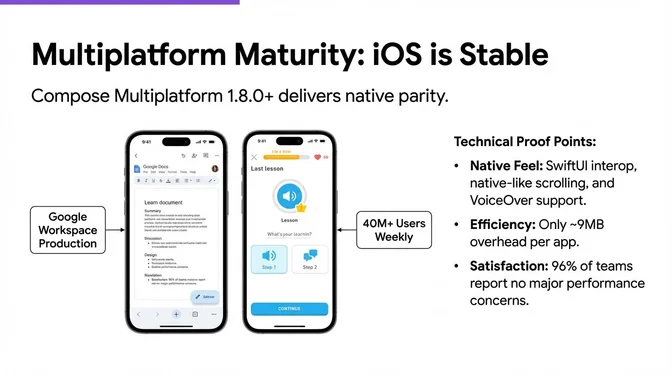
The year brought significant partnerships: JetBrains and Spring formalized Kotlin as first-class (27% of Spring developers have used Kotlin), JetBrains and Azul showed ~30-38% throughput gains on optimized JVMs, and Meta joined the Kotlin Foundation as its first Gold Member. Enterprise adoption grew rapidly: Google Workspace runs KMP in production in the Google Docs iOS app, JetBrains reports Duolingo ships weekly to 40M+ users with KMP, and JetBrains reports AWS usage in their SDK spanning 300+ services.
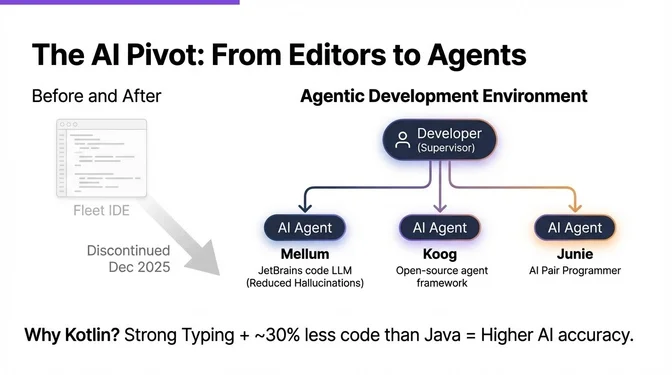
Yet, friction emerged: JetBrains discontinued Fleet IDE, Kotlin dropped to 25th on TIOBE sparking debates about ranking method versus domain strength, and K1 deprecation in IntelliJ triggered community reports of legacy Spring Boot 2 project breakage. The replacement, an agentic development environment, signals the company's bet on AI-supervised coding.
Actions for 2026: Migrate to K2 compiler now that JetBrains deprecated K1 in IntelliJ IDEA 2025.3, upgrade from KAPT to KSP for annotation processing, review Compose Multiplatform now that iOS is stable, plan for Spring Boot 4 GA with Kotlin 2.2 baseline.
Kotlin 2025 Timeline
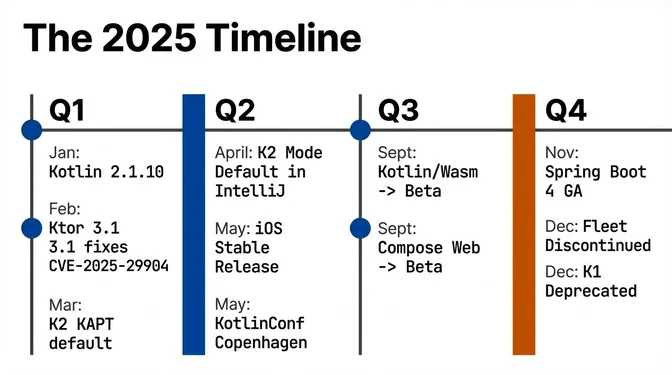
January 2025
February 2025
Ktor 3.1.0
Fleet KMP Deprecation
Ktor 3.1.1 Security Fix
March 2025
CVE-2025-29904 Published
Kotlin 2.1.20
Ktor 3.1.2
April 2025
TIOBE Ranking Drop
Jetpack Compose Update
May 2025
Compose iOS Stable
Azul Partnership
KotlinConf 2025
Amper 0.7.0
Spring Partnership
June 2025
Ktor 3.2.0
Kotlin 2.2.0
July 2025
Ktor 3.2.x Series
kotlinx-datetime 0.7.1
kotlin.time.Instant.Stack Overflow Survey
KotlinConf Recordings
Android Studio Narwhal
August 2025
kotlinx-rpc 0.9.1
Jetpack Compose Update
Modifier.dropShadow() and Modifier.innerShadow(), enhanced crash debugging.Next Edit Suggestions
September 2025
Kotlin 2.2.20
Compose Web Beta
October 2025
November 2025
Kotlin 2.3.0 RC
Spring Boot 4.0 GA
Meta Joins Foundation
December 2025
Android Studio Otter 2
K1 Deprecated
IntelliJ IDEA 2025.3
Fleet Discontinued
Kotlin 2.3.0
AI Assistant 2025.3
K2 Performance and Language Momentum
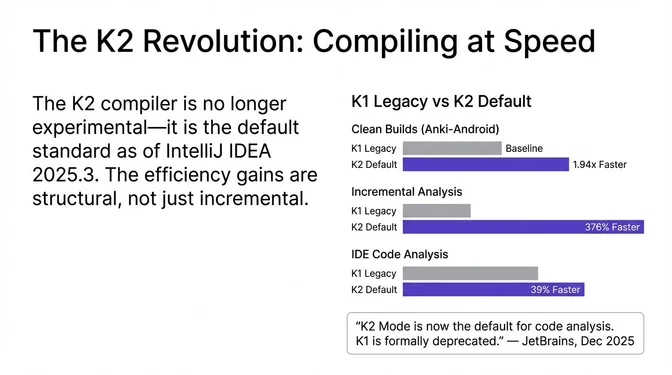
K2 performance gains are now documented across IDE and build workflows. JetBrains reports 40%+ compile time reductions in its IntelliJ monorepo, while K2 benchmarks show a ~1.94x faster Anki-Android clean build and 376% faster incremental analysis, with IDE code analysis and completion seeing ~39% and ~26% improvements in IntelliJ IDEA 2025.3. K2-Enabled features on the roadmap include Rich Errors, when guard conditions, and multi-dollar interpolation for template-heavy code.
Runtime and Build Speedups
Performance wins show up beyond the compiler: Kotlin on Azul Zing reports ~30-38% throughput gains and ~24-27% latency reductions, Gradle 9.0 improves Kotlin DSL feedback by 2.5x, KSP can be up to ~2x faster than KAPT, and Kotlin/Native release builds are up to 40% faster in 2.3.0. Tooling continues to move off KAPT toward KSP and Kotlin 2.x-aware rules.
Adoption Signals
Kotlin sits at 2.5 million developers worldwide and ranks 15th in the Stack Overflow 2025 survey (10.8%), with 51% wanting to continue using it. RedMonk places Kotlin at 14th, while TIOBE puts it at #25; JetBrains' 2025 developer ecosystem survey (24,534 developers across 194 countries) lists Kotlin as 6th in "want to adopt next" and 8% of backend developers' primary language. Kotlin usage in Spring is also measurable, with 27% of Spring developers reporting they have used it, and the Kotlin Slack community has crossed 100K users.
Enterprise Rollout
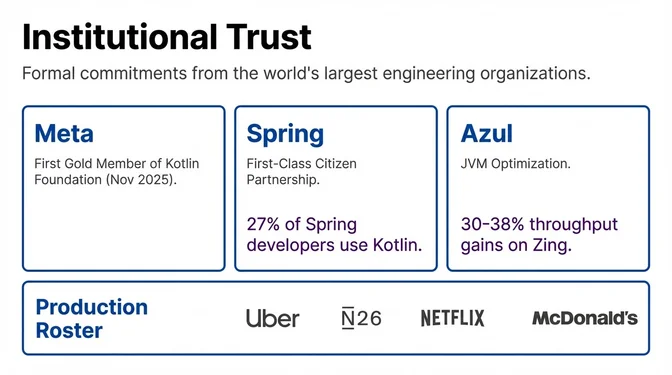
Adoption is increasingly enterprise-visible: Google Workspace runs KMP in production for the Google Docs iOS app, Duolingo ships weekly to 40M+ users with KMP features, and AWS reports its Kotlin SDK spans 300+ services across 8 platforms. JetBrains' KotlinConf stage highlights add further evidence of scale, citing Kotlin migrations or production deployments at companies like Uber, N26, ING, McDonald's, Netflix, Mercedes-Benz.io, Roblox, and others.
Kotlin 2026 Watchlist
1. K1 Compiler Deprecation
When: IntelliJ IDEA 2025.3 deprecated K1; removal timing is not yet specified.
Context: ~98% of projects already use K2, with ~1% still forcing the old mode. Legacy projects on Kotlin 1.5/1.6 (Spring Boot 2 era) may face IDE issues, with community reports of breakage.
Action: Upgrade to Kotlin 2.x and run ./gradlew build with K2 to identify compatibility issues. Migrate Spring Boot 2 projects to Spring Boot 3+ as prerequisite.
2. KAPT to KSP Migration
When: Now. KAPT may enter formal deprecation in 2026.
Context: KSP (Kotlin Symbol Processing) is typically faster than KAPT. Major libraries (Room, Moshi, Dagger) fully support KSP. KAPT is slow and incompatible with K2's full performance benefits.
Action: Audit build.gradle.kts for KAPT usage. Migrate annotation processors to KSP equivalents. Use ksp() instead of kapt() in dependency declarations.
3. Compose Multiplatform Production Adoption
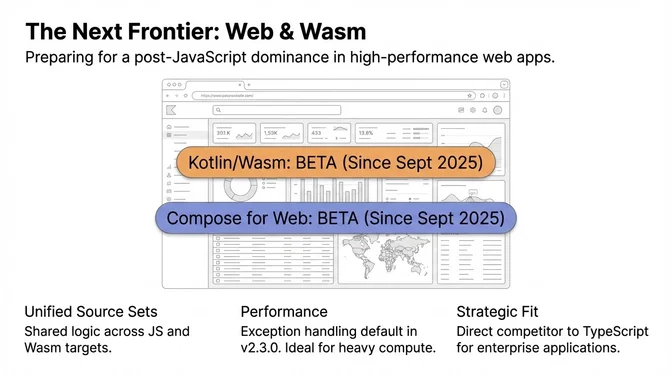
When: Now. iOS stable since May 2025, Web Beta since September 2025.
Context: 96% of teams report no major performance concerns on iOS. VoiceOver support, native-like scrolling, and SwiftUI interop remove previous blockers. ~9MB overhead per app.
Action: Review Compose Multiplatform for new cross-platform projects. Existing KMP projects: migrate shared UI from platform-specific to Compose. Web targets: review Beta for internal tools.
4. Kotlin 2.4.0 Features
When: Expected June-July 2026.
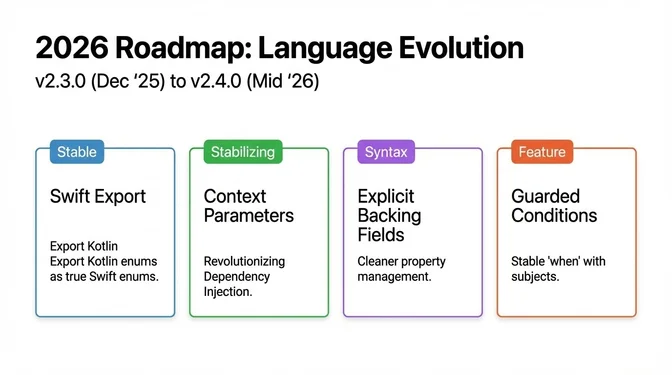
Context: Likely features: name-based destructuring stabilization, enhanced nullability checks, Context Parameters graduation to stable (enabling cleaner DI patterns), stable K2 compiler plugin API. Release cadence: six months for language releases, three months for tooling releases.
Action: Track Kotlin 2.3.20 (March-April 2026) for early feature previews. Enable experimental features in test projects to provide feedback.
5. Kotlin/Wasm Stabilization
When: Stable expected late 2026.
Context: Kotlin/Wasm graduated to Beta in September 2025. Exception handling enabled by default in 2.3.0. Unified shared source set for JS/Wasm simplifies multiplatform web targeting.
Action: Review for compute-intensive web applications where TypeScript performance falls short. Test with Compose for Web for full-stack Kotlin.
6. Spring Boot 4 Integration
When: Now. Spring Boot 4.0 GA with Kotlin 2.2 baseline.
Context: JetBrains-Spring partnership formalized Kotlin as first-class. Spring Boot 4 removes platform types through JSpecify integration, adds native kotlinx.serialization starter, with a Kotlin support deep dive. 27% of Spring developers have used Kotlin.
Action: Upgrade Spring Boot 3.x projects to 4.0. Enable kotlinx.serialization starter for JSON handling. Leverage JSpecify null-safety annotations.
7. Agentic IDE Evaluation
When: Broader preview expected 2026.
Context: JetBrains discontinued Fleet and is building a new agentic development environment where developers supervise AI agents. Success depends on whether developers embrace supervisory AI workflows.
Action: Track agentic IDE preview releases. Review against existing IDE + AI Assistant workflow. Consider for greenfield projects where AI-first development is acceptable.
8. Ktor Security Updates
When: Ongoing. Track Ktor releases.
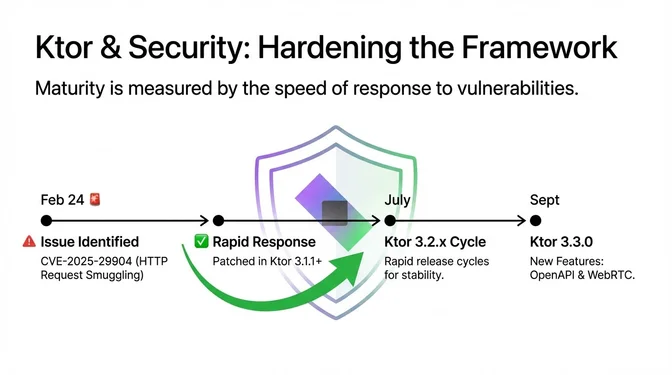
Context: CVE-2025-29904 (HTTP Request Smuggling) and CVE-2025-12543 (Undertow Host Header Bypass) showed attack surface in Kotlin web frameworks. Ktor 3.x received rapid patches throughout 2025.
Action: Pin Ktor to 3.3.0+ for new projects. Audit existing deployments for versions <3.1.1. Enable automatic dependency updates via Dependabot or Renovate.
9. Swift Export Production Readiness
When: Stable expected 2026. Beta since Kotlin 2.2.0.
Context: Swift Export enables producing Apple frameworks from Kotlin. Kotlin 2.3.0 exports enums as true Swift enums with variadic function support. Up to 40% faster release builds.
Action: Review for KMP projects targeting iOS. Replace manual Objective-C interop with Swift Export where possible. Test enum and variadic function exports.
10. KotlinConf 2026
When: May 20-22, 2026 in Munich, Germany.
Context: First "Golden Kodee Community Awards" ceremony. February 2026 marks 10 years since Kotlin 1.0 (February 2016), so expect retrospective celebrations and long-term vision announcements.
Action: Track CFP announcements for submission deadlines. Plan attendance for enterprise roadmap alignment.
11. Competitive Landscape
When: Ongoing through 2026.
Context: Java: Project Valhalla's value types may preview in 2026, potentially overlapping with Kotlin value classes. Java has caught up with records, pattern matching, and Project Loom virtual threads. Swift: SwiftWasm targets WebAssembly, potentially competing with Kotlin/Wasm. An opinion piece argued Kotlin needs a "big new killer feature" to maintain its edge.
Action: Track Java 23+ for Valhalla preview. Differentiate with KMP, DSL capabilities, and AI tooling. Review Kotlin/Wasm against SwiftWasm for web targets.
12. Deprecation Deadlines
When: Throughout 2026.
Context: Key deprecations affecting legacy projects:
- kotlin-android-extensions plugin produces configuration errors in 2.3.0
- Ant build system support removed in 2.3.0
- Baseline Apple targets: iOS/tvOS 14.0, watchOS 7.0
- K1 compiler support deprecated in IntelliJ 2025.3 (removal timing TBD)
- KAPT may enter formal deprecation as KSP adoption grows
Action: Audit projects for deprecated features. Migrate kotlin-android-extensions to View Binding or Compose. Upgrade baseline deployment targets for Apple platforms.
13. AI Tooling Adoption
When: Ongoing. Koog, Mellum, Junie, and the AI Assistant 2025.3 line are available now.
Context: Mellum is a JetBrains code LLM with a Kotlin-fine-tuned variant open-sourced in 2025, leveraging K2's semantic understanding for "compiler-verified" AI with reduced hallucinations. Koog enables building AI agents in type-safe Kotlin with Model Context Protocol (MCP) support. Junie showed at KotlinConf as AI pair programmer handling multi-module tasks. JetBrains cites Kotlin as ~30% less code and ~25% fewer bugs than Java, making it more "AI-friendly." Stack Overflow 2025 shows 46% of developers distrust AI accuracy (only 3% highly trust), so adoption requires validation. Agent Client Protocol (ACP) developed with Zed aims to standardize AI agent integration across IDEs.
Action: Review Mellum/AI Assistant for Kotlin-specific code completion. Consider Koog for AI agent development if currently using Python frameworks. Add code review for AI-generated code.
14. Kotlin Upskill Program
When: Expanding in 2026.
Context: JetBrains partnered with Xebia Academy for intensive Kotlin Upskill Program in 2025. Trend likely to expand with more official training pathways for enterprises.
Action: Review official training for teams adopting Kotlin. Track new certification offerings.
15. Supply Chain Security
When: Ongoing. Track dependencies continuously.
Context: In September 2025, one npm supply-chain campaign targeted 18 popular packages with billions of weekly downloads, with payloads aimed at crypto wallets. Separately, the self-propagating "Shai-Hulud" worm compromised hundreds of packages and harvested credentials; Shai-Hulud 2.0 escalated execution to the preinstall phase. These incidents primarily affected JavaScript ecosystems but could affect Kotlin/JS and KMP projects with JS targets. No Kotlin-specific incidents reported, but the ecosystem relies on Gradle and Maven Central. Qodana used by JetBrains on Kotlin codebase for quality assurance.
Action: Enable Gradle dependency checksum verification. Configure OWASP Dependency Check or GitHub Dependabot. Audit build.gradle.kts dependencies in multiplatform projects, especially JS targets.