State of PHP 2026

January 10, 2026

PHP celebrated its 30th anniversary in 2025 while shipping PHP 8.5 with the pipe operator, clone with modifications, and a native URI extension. FrankenPHP gained official PHP Foundation support, delivering benchmark results showing ~15,000 req/sec vs PHP-FPM's ~4,000 in worker mode, becoming an alternative runtime backed by the Foundation. The ecosystem achieved 89% PHP 8.x adoption while PHP powered ~72% of websites with detectable server-side languages, though PHP dropped out of TIOBE's top 10 in April 2024, ranking #13 in January 2025 and #15 by January 2026.
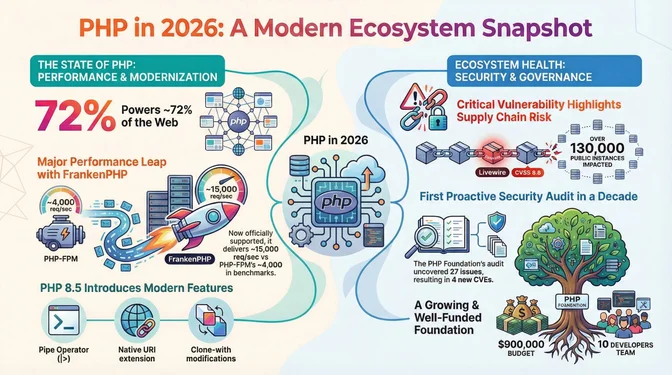
Infographic titled "PHP in 2026: A Modern Ecosystem Snapshot" summarizing the state of PHP in 2026. On the left, it highlights performance and modernization, noting that PHP powers roughly 72% of the web, with major performance improvements driven by FrankenPHP, which delivers about 15,000 requests per second compared to PHP-FPM's roughly 4,000. It also highlights PHP 8.5 introducing modern features such as the pipe operator, a native URI extension, and clone-with-modifications. On the right, it focuses on ecosystem health, security, and governance, showing critical supply-chain vulnerabilities impacting over 130,000 public instances, the first proactive security audit in a decade uncovering 27 issues and four new CVEs, and a growing, well-funded PHP Foundation with an approximately $900,000 budget and a 10-developer team.
PHP in 2026: Performance Gains Meet a Stronger, Safer Ecosystem

Laravel and Symfony executed vertical integration strategies: Laravel 12 launched with zero breaking changes alongside Laravel Cloud and Nightwatch tracking, while Symfony released 7.4 LTS and 8.0 simultaneously with identical features but diverging support paths. Security defined the year's challenges: Livewire's critical RCE (CVE-2025-54068, CVSS v4.0 9.2 / v3.1 9.8) with 130,000+ public Livewire instances detected (vulnerable subset depends on version/configuration), while leaked APP_KEY values on GitHub exposed 600+ Laravel apps. The PHP Foundation commissioned its first security audit in over a decade, managed an $900,000 budget with 10 part-time/full-time developers, and began searching for its first full-time Executive Director.

Actions for 2026: Patch React2Shell (CVE-2025-55182) if using RSC frameworks, test PHP 8.6's partial function application (unanimously approved 33-0-0), plan WordPress 7.0 migration (Beta Feb 19, GA Apr 9), review FrankenPHP for production workloads, migrate off PHP 8.1 before December 31 EOL.


PHP 2025 Timeline
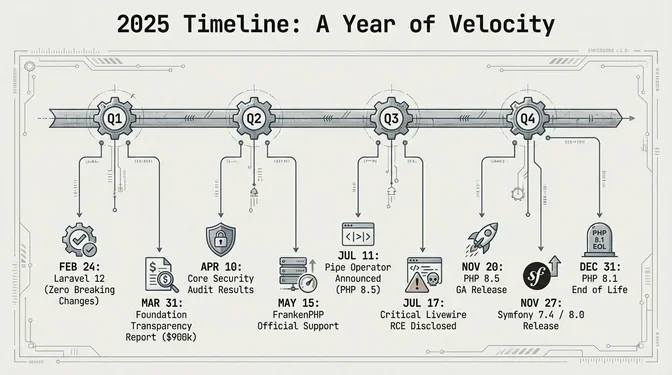
Timeline graphic titled "2025 Timeline: A Year of Velocity" showing major milestones in the PHP ecosystem throughout 2025. In Q1, it highlights Laravel 12 releasing on February 24 with zero breaking changes, the PHP Foundation publishing a transparency report on March 31 showing roughly $900K in funding, and a core security audit completed on April 10. In Q2, FrankenPHP gains official support on May 15. In Q3, the PHP team announces PHP 8.5's pipe operator on July 11, followed by disclosure of a critical Livewire remote code execution vulnerability on July 17. In Q4, PHP 8.5 reaches general availability on November 20, Symfony 7.4 and 8.0 release on November 27, and PHP 8.1 reaches end of life on December 31.
PHP in 2025: A Year of Velocity Across the Ecosystem

January 2025

January 10
release

Laravel Herd 1.14

Laravel Herd 1.14 set PHP 8.4 as default for new installations, added Expose 3.0 integration, herd ini CLI command. PHPStan 2.1.x releases refined PHP 8.4 Property Hooks support from November 2024's Level 10 launch.
January 13
release

PHP 8.3.16

PHP 8.3.16 released with bug fixes.
January 16
release

PHP 8.4.3

PHP 8.4.3 released with bug fixes.
January 16-17
event

SymfonyOnline 2025

SymfonyOnline 2025 opened the year's conference calendar.
January 29
security

Twig CVE-2025-24374

Twig CVE-2025-24374 disclosed: missing output escaping in null coalesce operator (??), medium-severity XSS affecting Twig versions before 3.19.0. Fixed in Twig 3.19.0.

February 2025

February 3-4
event

Laracon EU 2025

Laracon EU 2025 in Amsterdam drew 700+ attendees. Taylor Otwell showed Laravel Cloud, Jess Archer presented Nightwatch, Aaron Francis announced Fusion (PHP inside Vue.js components).
February 13
release

PHP 8.3.17 and 8.4.4

February 19
event

PHP UK Conference 20th Anniversary

PHP UK Conference 20th anniversary in London featuring Daniel Terhorst-North's keynote on 20 years of BDD.
February 24
release

Laravel 12

Laravel 12 released, the first major version with zero breaking changes. New starter kits (React, Vue, Livewire 3), WorkOS AuthKit integration, needs Carbon 3.x, PHP 8.2-8.4 compatibility.

March 2025

March 5
security

Laravel CVE-2025-27515

Laravel CVE-2025-27515 disclosed: file validation bypass with wildcards (files.*) affecting versions before 10.48.29, 11.44.0. Fixed in 10.48.29, 11.44.1, 12.1.1.
March 8-9
event

Laracon India 2025

Laracon India 2025 in Gandhinagar drew 2,500+ attendees from 20+ countries, the first official Laracon India.
March 13
security

Coordinated Security Release

Coordinated security release: PHP 8.1.32, 8.2.28, 8.3.19, 8.4.5, the first 2025 releases for PHP 8.1 and 8.2 (both in security-only mode). All versions address CVE-2025-1219, a libxml streams vulnerability where libxml may parse redirected HTTP resources with the wrong charset due to header handling, potentially bypassing validation.
announcement

PXP Project Archived

PXP project archived: Ryan Chandler's PHP superset experiment (analogous to TypeScript for JavaScript) ceased development. The decision reflected PHP core's faster pace, as PHP core was either adding features PXP aimed to provide natively or static analysis tools like PHPStan handled them, signaling that PHP innovation belongs within the engine itself rather than fragmented dialects.
March 17
event

SymfonyDay Chicago

SymfonyDay Chicago included tribute to Ryan Weaver, who would pass away in August.
March 27-28
event

SymfonyLive Paris 2025

SymfonyLive Paris 2025 kicked off Symfony's 20th anniversary celebrations.
March 29
release

CakePHP 5.2.0

CakePHP 5.2.0 released with cake counter_cache command and nativeuuid type for MariaDB.
March 31
announcement

PHP Foundation Transparency Report

PHP Foundation published 2024 Transparency Report: $683,550 in donations, plans to spend up to $900,000 on developer compensation in 2025.

April 2025

April 3
announcement

Passbolt Joins PHP Foundation

April 3-4
event

SymfonyLive Berlin

SymfonyLive Berlin previewed Symfony 7.3 features.
April 4
release

Composer 2.8.8

April 10
milestone

PHP Foundation Security Audit

PHP Foundation published first comprehensive security audit results in over a decade. Commissioned via Sovereign Tech Agency, conducted by Quarkslab/OSTIF. Found 27 issues (17 with security implications), 4 CVEs issued, 3 high-severity. All addressed before publication.
release

PHP 8.3.20 and 8.4.6

PHP 8.3.20 and 8.4.6 released as bug fix releases, incorporating fixes developed during the security audit process.
April 16
release

PyCharm 2025.1

PyCharm 2025.1 merged Professional and Community editions, making core features (including Jupyter) free.

May 2025

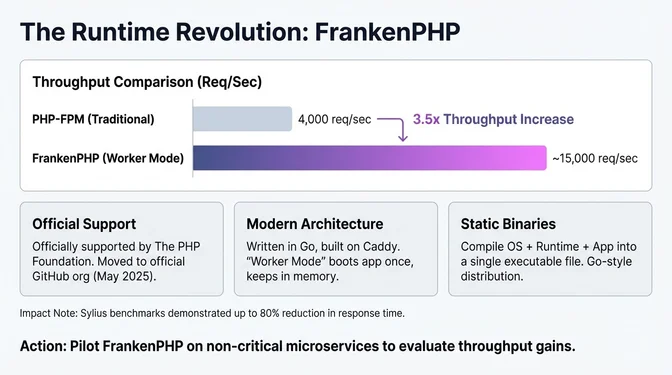
Infographic titled "The Runtime Revolution: FrankenPHP" comparing request throughput between traditional PHP-FPM and FrankenPHP. It shows PHP-FPM handling roughly 4,000 requests per second, while FrankenPHP running in worker mode achieves approximately 15,000 requests per second, representing about a 3.5x throughput increase. The graphic notes that FrankenPHP is officially supported by the PHP Foundation and moved to the official PHP GitHub organization in May 2025. More callouts describe FrankenPHP's modern architecture (written in Go and built on Caddy, with worker mode booting the application once and keeping it in memory) and its ability to produce static binaries that bundle the OS, runtime, and application into a single executable.
The Runtime Revolution: FrankenPHP Redefines PHP Performance
May 15
milestone

FrankenPHP Official Support

FrankenPHP became officially supported by The PHP Foundation. Project moved to official PHP GitHub organization. Independent benchmarks showed ~15,000 req/sec vs PHP-FPM's ~4,000 in specific test conditions; Sylius analysis showed 80% response time reduction with worker mode (performance gains vary by application architecture). Version 1.5 introduced thread autoscaling with dynamic worker thread spawning based on traffic load (mirroring PHP-FPM's pm.dynamic but with Go routine overhead). "Mostly static" binary builds enable compiling application code, PHP runtime, extensions, and web server into single portable binaries.
May 15-16
event

phpDay 2025

phpDay 2025 in Verona, 22nd edition with hybrid attendance.
May 19
security

Symfony UX CVE-2025-47946

Symfony UX CVE-2025-47946: unsanitized HTML attribute injection in symfony/ux-twig-component before 2.25.1, enabling XSS.
May 20-22
event

php[tek] 2025

php[tek] 2025 in Chicago celebrated 17th year. Security theme: "Developer Enablement", moving from gatekeeping to paving the road.
May 25
security

Laravel REST API CVE-2025-48490

Laravel lomkit/laravel-rest-api CVE-2025-48490 disclosed: validations for same attribute could be silently overridden in versions before 2.13.0.
May 29
release

Symfony 7.3

Symfony 7.3 released with three new components: JsonStreamer, ObjectMapper, JsonPath. Added invokable commands with PHP attributes, asset pre-compression, native PHP 8.4 lazy object support.

June 2025

June 5
release

PHP 8.3.22 and 8.4.8

June 8
milestone

PHP's 30th Anniversary

PHP's 30th anniversary. PHP Foundation announced FrankenPHP move to official GitHub organization.
June 12-13
event

SymfonyOnline June 2025

SymfonyOnline June 2025 featured keynote "Symfony in 2025: Scaling to Zero", a performance initiative for serverless environments.
June 16
release

Laravel Nightwatch

Laravel Nightwatch shipped, a tracking solution with minimal performance impact (buffering data until 8 MB or 10 seconds), battle-tested on Laravel Forge for two months before public release.
June 17
event

JetBrains PHPverse 2025

JetBrains PHPverse 2025, a free online conference celebrating PHP's 30th with 26,000+ attendees worldwide. Featured talks by core contributors and PHP 8.5 release managers.
release

PIE 1.0.0

PIE 1.0.0 released: PHP Installer for Extensions, modernizing PECL replacement. Spearheaded by James Titcumb ("asgrim").
June 28
event

PHP Conference Japan 2025

PHP Conference Japan 2025 in Tokyo drew 875 of 1,700 registered attendees.
release

Doctrine ORM 3.4.0

Doctrine ORM 3.4.0 released with native lazy object support and PHP 8.4 property hooks compatibility.

July 2025

July 3
security

Coordinated Security Release

PHP 8.4.10 released (security); the release team skipped 8.4.9 because they tagged the release without including security patches. Coordinated security release: PHP 8.1.33, 8.2.29, 8.3.23, 8.4.10 addressing CVE-2025-1220 (Low severity, fsockopen() null byte hostname validation bypass) and CVE-2025-1735 (PostgreSQL driver string escaping flaw. PHP 8.5.0 Alpha 1 released.
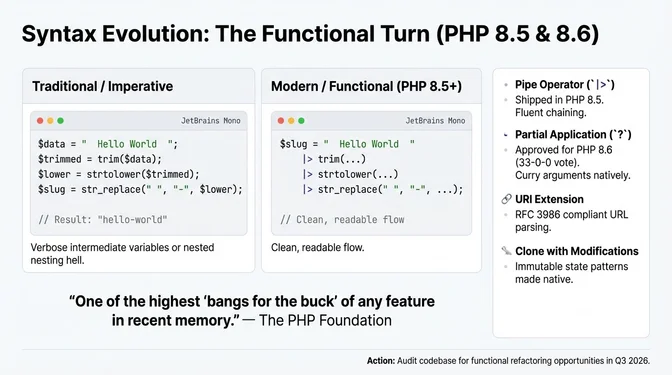
Infographic titled "Syntax Evolution: The Functional Turn (PHP 8.5 & 8.6)" comparing traditional imperative PHP code with a modern functional style introduced in PHP 8.5 and later. On the left, it shows verbose imperative code with intermediate variables and nested function calls. In the center, it shows the new functional style using the pipe operator (|>) to create clean, readable transformation flows. On the right, it lists key language features: the pipe operator shipped in PHP 8.5 for fluent chaining, partial application (?) approved for PHP 8.6 enabling native currying, an RFC 3986-compliant URI extension, and clone-with-modifications for immutable state patterns.
PHP's Functional Turn: How PHP 8.5 and 8.6 Modernize Syntax
July 11
announcement

PHP 8.5 Pipe Operator

PHP Foundation announced pipe operator (|>) for PHP 8.5. Larry Garfield's third RFC attempt succeeded. Implementation by Ilija Tovilo and Arnaud Le Blanc. Foundation called it "one of the highest 'bangs for the buck' of any feature in recent memory".
July 17
release

PHP 8.5.0 Alpha 2

PHP 8.5.0 Alpha 2 released (Alpha 3 planned for Jul 31).
security

Livewire CVE-2025-54068

July 29-30
event

Laracon US 2025

Laracon US 2025 in Denver. Major announcements: Laravel Cloud enhancements (MySQL backups, Preview Environments, WebSockets GA, Canada region), Laravel Forge 2.0 (complete rebuild, zero-downtime deployments, Laravel VPS), Livewire 4 preview (Blaze Rendering Engine for 3× faster UIs), Pest 4 announcement (Playwright browser testing).

August 2025

August 1
release

PHP 8.5.0 Alpha 4

August 5
announcement

Compile-Time Generics Proposal

PHP Foundation published Gina Banyard's compile-time generics proposal for interfaces/abstract classes only, avoiding runtime overhead. Community response mixed; no immediate RFC vote.
August 14
release

PHP 8.5.0 Beta 1

PHP 8.5.0 Beta 1 released. Beta 2 (Aug 28), Beta 3 (Sep 11) followed.
milestone

FrankenPHP 10,000 Stars

August 21
release

Pest 4.0

Pest 4.0 launched at Laravel Live Denmark with 39M+ installs (up from 18M in 2024). Playwright browser testing, visual regression, test sharding, built on PHPUnit 12, requires PHP 8.3+.
August 23
release

Guzzle 7.10.0

Guzzle 7.10.0 released with PHP 8.5 support.
August 24
release

Slim Framework 4.15.0

August 28
release

PHP 8.3.25 and 8.4.12

PHP 8.3.25 and 8.4.12 maintenance releases.
event

Ryan Weaver Memorial

PHP and Symfony communities mourned loss of Ryan Weaver, who passed away after battling brain cancer. SymfonyCasts founder, Symfony Core Team member, beloved educator.

September 2025

September 5
announcement

PHP MCP SDK

September 11
release

PHP 8.5.0 Beta 3

PHP 8.5.0 Beta 3 released.
September 14
event

Laracon Online

Laracon Online, a free YouTube-streamed event with 8 main talks, 10 lightning talks.
September 18
release

API Platform 4.2

API Platform 4.2 released: JsonStreamer integration (~32.4% req/sec increase), ObjectMapper integration, FrankenPHP support (3× more req/sec in worker mode), enhanced Laravel integration (124 PRs).
September 25
release

PHP 8.5.0 RC1

PHP 8.5.0 RC1 released alongside PHP 8.3.26 and 8.4.13 maintenance releases.
announcement

Joe Watkins Joins PHP Foundation

Joe Watkins (pthreads creator) joined PHP Foundation as contractor. Expertise applied to Streams API rework.
September 29
release

pandas 2.3.3

pandas 2.3.3 released, the first release supporting Python 3.14 including 3.14t wheels.

October 2025

October 1
release

Laravel Forge 2.0

Laravel Forge 2.0 launched, the biggest update since 2014. Zero-downtime deployments, Laravel VPS, sub-10-second provisioning, health checks, JSON:API compliance.
October 8
announcement

Doctrine ORM 2.x Extended Support

Doctrine team announced ORM 2.x support extended to February 2027 (from February 2026).
October 9
release

PHP 8.5.0 RC2

PHP 8.5.0 RC2 released. RC3 (Oct 23), RC4 (Nov 6), RC5 (Nov 13) followed.
October 9-10
event

Forum PHP 2025

Forum PHP 2025 in Paris drew 700+ attendees.
October 10
announcement

PHP 8.5 URI Extension

PHP Foundation announced new URI Extension for PHP 8.5 with modern URL parsing following RFC 3986/WHATWG standards, developed through collaboration with Symfony and community contributors.
October 15
milestone

State of PHP 2025 Survey

State of PHP 2025 survey published (1,720 respondents): 89% using PHP 8.x, 64% Laravel, 36% PHPStan (+9 points YoY), 17% Pest (+4 points), 68% PhpStorm (+10%), 95% tried AI-assisted coding, 80% use AI tools regularly.
October 22
announcement

Sovereign Tech Agency Second Investment

November 2025

November 10
announcement

PHP Foundation Executive Director Search

PHP Foundation announced search for new Executive Director. Roman Pronskiy stepping down after founding role. Application deadline: December 15, 2025.
November 13-14
event

Laracon AU 2025

Laracon AU 2025 in Brisbane.
November 20
release

PHP 8.3.28 and 8.4.15

PHP 8.3.28 and 8.4.15 maintenance releases.
November 27
release

Symfony 7.4 LTS and 8.0

Symfony 7.4 LTS and 8.0 released simultaneously with identical features. 7.4 LTS: bug fixes until 2028, security until 2029, requires PHP 8.2+. 8.0: requires PHP 8.4.0+, removes deprecated code. New features include native FrankenPHP worker-mode integration, caching HTTP client, video constraint, multi-step forms.
November 27-28
event

SymfonyCon Amsterdam 2025

SymfonyCon Amsterdam 2025 drew 1,200+ attendees for Symfony's 20th anniversary. Fabien Potencier keynote: "20 Years of Symfony, What's Next?"

December 2025

December 2
release

WordPress 6.9 "Gene"

WordPress 6.9 "Gene" released with major features: Notes (inline collaboration), Abilities API for granular permissions, Pattern Zoom for full-screen editing, Font Library enhancements, 90+ block improvements.
December 4
release

Xdebug 3.5.0

Xdebug 3.5.0 released with PHP 8.5 support, native path mapping, Windows Named Pipes.
December 8
announcement

PHP 8.6 Partial Function Application

PHP Foundation confirmed partial function application for PHP 8.6. Unanimously accepted 33-0-0. Complements pipe operator, enables currying/deferred arguments.
December 9
announcement

MCP Donated to Linux Foundation

Anthropic donated MCP to Linux Foundation, establishing Agentic AI Foundation (AAIF) with vendor-neutral governance. Strengthens Go/PHP MCP SDK investments.
December 15
release

JupyterLab 4.5.1

December 18
announcement

WordPress 7.0 Delayed

WordPress 7.0 officially pushed to 2026. Official schedule proposed: Beta Feb 19, RC Mar 19, GA Apr 9, 2026. Legal issues and WP Engine lawsuit introduced governance uncertainties; Automattic reduced sponsored contributions in January 2025 before resuming fuller engagement in May.
security

Final 2025 Coordinated Security Releases

Final 2025 coordinated security releases: PHP 8.1.34 (final release, 8.1 EOL Dec 31), 8.2.30 (4 security bugs), 8.3.29 (CVE-2025-14177, 14178, 14180), 8.4.16 (4 CVEs), 8.5.1 (first 8.5 security patch). Notable vulnerabilities included: CVE-2025-14180 (PDO PostgreSQL NULL pointer deref), CVE-2025-14178 (heap buffer overflow in array_merge(), CVSS 6.5 MEDIUM), CVE-2025-14177 (getimagesize() uninitialized heap memory leak).
December 24
release

Symfony AI v0.1.0

Symfony AI v0.1.0 tagged with 75+ packages, 25+ AI provider connectors, and MCP integration (2,000+ commits from 80+ contributors).
December 25
release

Rector 2.3.0

Rector 2.3.0 released with FileNode for file-level changes.
December 31
milestone

PHP 8.1 End of Life

PHP 8.1 reached end of life after 4 years. Major hosting providers forced automatic upgrades to PHP 8.4. Triggered massive Q3/Q4 migration effort.
release

Yii 3.0

Yii 3.0 officially released after years of development. Complete architectural rewrite: container-based, PSR-7/11/15 compliant, worker mode support (RoadRunner, Swoole, FrankenPHP), three templates (Web, API, Console).

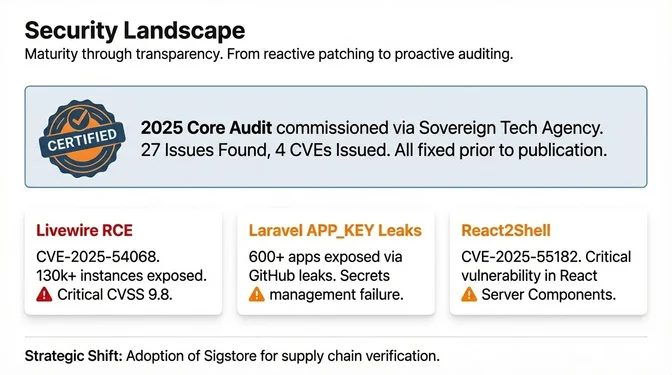
Security Landscape

Infographic titled "Security Landscape" describing a shift toward greater security maturity through transparency and proactive auditing. It highlights a 2025 core security audit commissioned via the Sovereign Tech Agency that identified 27 issues, resulted in four CVEs, and was fully remediated before publication. Below, the infographic summarizes three major incidents: a Livewire remote code execution vulnerability (CVE-2025-54068) with a critical CVSS 9.8 rating impacting over 130,000 instances; widespread Laravel APP_KEY leaks affecting more than 600 applications due to secrets management failures; and the React2Shell vulnerability (CVE-2025-55182), a critical flaw in React Server Components. A concluding note emphasizes a strategic shift toward adopting Sigstore for software supply-chain verification.
Security Landscape: From Reactive Patching to Proactive Assurance

PHP core addressed six CVEs in 2025, including CVE-2025-1219 (libxml charset bypass), CVE-2025-1735 (PostgreSQL escaping flaw, CNA CVSS 5.9 / NIST 7.5), and December's cluster including CVE-2025-14178 (array_merge() overflow) and CVE-2025-14180 (PDO PostgreSQL NULL deref). Framework vulnerabilities ranged from Twig's XSS via null coalesce (fixed in 3.19.0) to Livewire's critical RCE (CVSS v4.0 9.2 / v3.1 9.8, fixed in 3.6.4), with 130,000+ public instances detected. leaked APP_KEY values on GitHub exposed 600+ Laravel apps.

The PHP Foundation's first comprehensive audit in over a decade found 27 issues, issuing 4 CVEs. Enterprise adoption remained strong: Slack documented PHP-to-HHVM transitions, Vimeo detailed static analysis (Psalm) for millions of legacy lines, and Wikipedia continued MediaWiki's PHP 8.x migration.

Market Position

PHP powered ~72% of websites with detectable server-side languages as of January 9, 2026, with 89% developer adoption of PHP 8.x per JetBrains. TIOBE rankings dropped from #13 (Jan 2025) to #15 (Jan 2026) after exiting the top 10 in April 2024. Framework adoption showed Laravel at 64%, Symfony 23%, WordPress 25%, with rising tooling: PHPStan 36% (+9 points) and Pest 17% (+4 points).

Framework Strategies
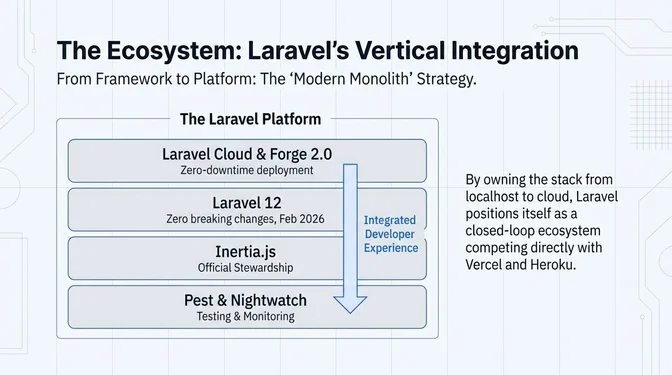
Infographic titled "The Ecosystem: Laravel's Vertical Integration" illustrating Laravel's strategy of evolving from a framework into a fully integrated platform. The diagram stacks core components of the Laravel platform, including Laravel Cloud and Forge 2.0 for zero-downtime deployments, Laravel 12 with zero breaking changes (released February 2026), Inertia.js under official stewardship for frontend integration, and Pest and Nightwatch for testing and tracking. An arrow labeled "Integrated Developer Experience" emphasizes tight coupling across the stack. A side note explains that by owning the workflow from localhost to cloud, Laravel positions itself as a closed-loop ecosystem competing directly with platforms like Vercel and Heroku.
Laravel's Vertical Integration: From Framework to Full-Stack Platform

Laravel took over Inertia.js stewardship to complete vertical integration: framework, Laravel Cloud deployment, Forge 2.0, Nightwatch tracking, Pest testing, and Inertia/Livewire frontends, positioning itself as a Vercel/Heroku competitor with framework-aware optimizations.
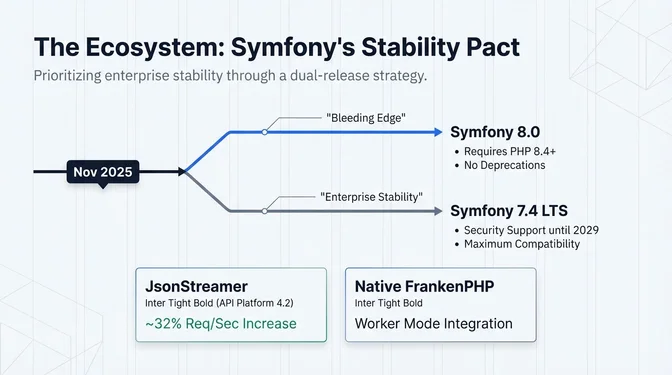
Infographic titled "The Ecosystem: Symfony's Stability Pact" illustrating Symfony's dual-release strategy introduced in November 2025. The diagram shows the framework splitting into two paths: a "Bleeding Edge" track leading to Symfony 8.0, which requires PHP 8.4 or newer and introduces no deprecations, and an "Enterprise Stability" track leading to Symfony 7.4 LTS, offering full compatibility with security support through 2029. More callouts highlight performance and runtime advances, including JsonStreamer integration in API Platform 4.2 delivering roughly a 32% increase in requests per second, and native FrankenPHP support with worker mode integration for improved throughput.
Symfony's Stability Pact: Balancing Innovation and Long-Term Support

Symfony 7.3 shipped JsonStreamer and ObjectMapper for memory-efficient APIs, then released 7.4 LTS and 8.0 simultaneously with identical features but diverging support (7.4: security until 2029; 8.0: requires PHP 8.4+).

Tooling Evolution
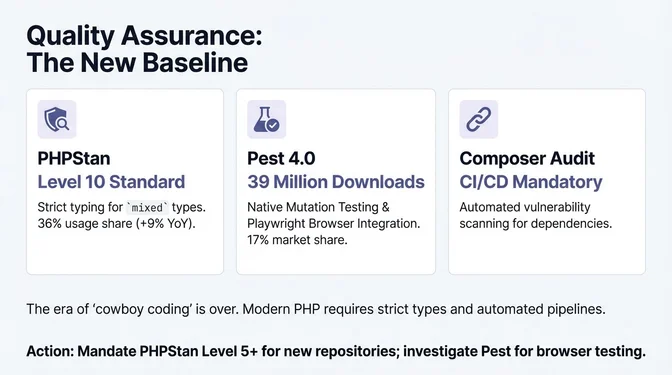
Infographic titled "Quality Assurance: The New Baseline" highlighting elevated QA standards in the PHP ecosystem. It shows PHPStan Level 10 becoming the standard, enforcing strict typing for mixed types with a 36% usage share and 9% year-over-year growth. It also highlights Pest 4.0 reaching 39 million downloads, offering native mutation testing and Playwright browser integration, with a 17% market share. A third panel notes that Composer Audit is now mandatory in CI/CD pipelines, enabling automated dependency vulnerability scanning. A concluding statement emphasizes the end of "cowboy coding" and recommends mandating PHPStan Level 5 or higher for new repositories and evaluating Pest for browser testing.
Quality Assurance as the New Baseline in Modern PHP

PHPStan 2.0's Level 10 targeting mixed types became a quality badge for open-source packages, with `list<T>` types distinguishing sequential from associative arrays. Pest 3 added native mutation testing to prevent false-positive tests; Pest 4 (39M+ installs, up from 18M in 2024) added Playwright browser testing and visual regression. composer audit integration became standard in CI/CD pipelines.

PHP Foundation

Managed $900,000 budget (up from $683,550 in 2024 donations from 658 sponsors) with 550+ donations in 2025. Key initiatives included the security audit (27 issues, 4 CVEs), FrankenPHP official support, PHP MCP SDK (Anthropic/Symfony collaboration), PIE 1.0 (PECL replacement), and Sovereign Tech Agency-funded stream layer improvements. The 10-developer team (expanding to 12 in 2026) includes Arnaud Le Blanc, Gina Peter Banyard, Ilija Tovilo, James Titcumb, and Joe Watkins (joined September). The Foundation began searching for its first full-time Executive Director.

Conference Ecosystem

Major gatherings included Laracon India (2,500+, first official), SymfonyCon Amsterdam (1,200+, Symfony's 20th), JetBrains PHPverse (26,000+ online, PHP's 30th), Laracon EU (700+), and Forum PHP (700+). Japan hosted 10+ regional conferences including PHP Conference Hiroshima (first edition) and Fukuoka (10th/final).


PHP 2026 Watchlist
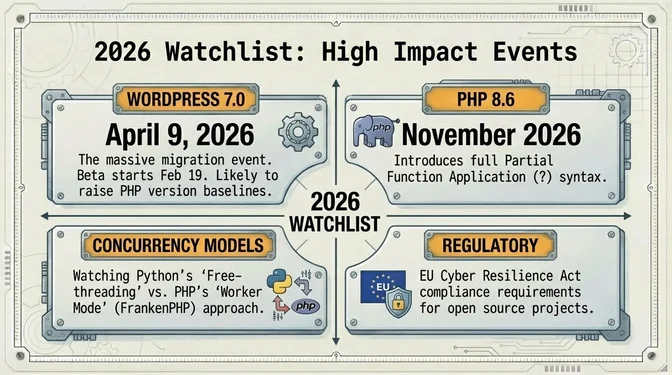
Infographic titled "2026 Watchlist: High Impact Events" highlighting key developments to track in 2026. It lists WordPress 7.0 releasing on April 9, 2026, with beta starting February 19 and triggering a massive migration likely to raise PHP version baselines. It highlights PHP 8.6 arriving in November 2026, introducing full partial function application syntax. Another panel tracks concurrency models, comparing Python's emerging free-threading approach with PHP's worker-mode strategy via FrankenPHP. A final panel notes regulatory considerations, specifically compliance requirements for open source projects under the EU Cyber Resilience Act.
2026 Watchlist: High-Impact Events Shaping the PHP Ecosystem

1. PHP 8.6 and Partial Function Application

When: November 2026.
Context: Partial function application unanimously accepted 33-0-0 for PHP 8.6. Enables placeholder syntax (?) for partial callable application, complementing the pipe operator. For example: $addFive = add(?, 5); $result = $addFive(3); returns 8. Works hand-in-hand with pipe operator to bring functional patterns natively to PHP. More features likely: `clamp()` function, potential async improvements, continued JIT enhancements.
Action: Test partial application patterns in development. Plan migration timeline from 8.3/8.4 to 8.6. Audit codebase for opportunities to leverage functional composition.


2. Free-Threading Maturity (Python Context)

When: Track through 2026.
Context: While Python 3.14's GIL-optional builds showed the path forward, PHP's ecosystem hasn't announced similar plans. Yet, FrankenPHP's worker mode already delivers multi-request state reuse without traditional threading. The performance gains (3.5×) suggest alternative concurrency models may be more pragmatic for PHP than GIL removal.
Action: Review FrankenPHP for CPU-bound workloads. Track PHP internals discussions for any async/concurrency proposals targeting PHP 9.0.


3. WordPress 7.0 Launch
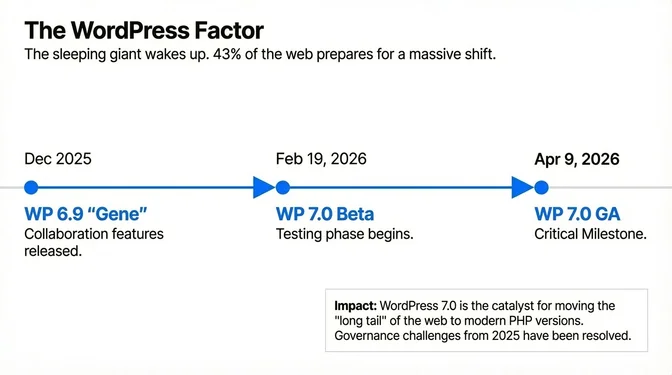
Timeline graphic titled "The WordPress Factor" showing key milestones leading to WordPress 7.0. It begins in December 2025 with the release of WordPress 6.9 "Gene," introducing new collaboration features. The timeline continues to February 19, 2026, marking the start of the WordPress 7.0 beta testing phase, and culminates on April 9, 2026, with the general availability release of WordPress 7.0. A callout notes that WordPress 7.0 is a critical catalyst for moving the long tail of the web (representing about 43% of sites), to modern PHP versions, and that the community resolved governance challenges from 2025.
The WordPress Factor: A Timeline to the WP 7.0 Inflection Point

When: Official schedule: Beta February 19, RC March 19, GA April 9, 2026.
Context: Major version delayed from late 2025 due to WP Engine legal issues. Automattic reduced sponsored contributions in January 2025 before resuming fuller engagement in May. WordPress 6.9 shipped December 2, 2025 with major features (Notes collaboration, Abilities API, Pattern Zoom). Version 7.0 will likely build on Gutenberg phase 3 collaborative editing capabilities and possibly require higher PHP baseline. WordPress powers ~43% of all websites, making this launch critical for PHP ecosystem health.
Action: Plan WordPress 7.0 testing for staging environments starting with Beta (Feb 19). If on WordPress 6.x, prepare migration strategy. Track WordPress governance stabilization. Test against Beta and RC releases before April 9 GA.


4. FrankenPHP Production Adoption

When: Now through 2026.
Context: Official PHP Foundation support validates FrankenPHP as production-ready. Benchmarks show 3.5× performance improvements, 80% response time reduction, and 15,000 req/sec vs PHP-FPM's 4,000. Native HTTP/2, HTTP/3, automatic HTTPS. Worker mode keeps application kernel in memory across requests.
Action: Pilot FrankenPHP in non-critical environments. Benchmark against existing PHP-FPM setup. Review for Laravel/Symfony applications with high traffic or cost-sensitive deployments. Consider static binary builds for simplified distribution.


5. PHP Foundation Executive Director Transition

When: Early 2026.
Context: Search announced November 10, 2025 for first full-time Executive Director after Roman Pronskiy stepped down. Application deadline: December 15, 2025. New leadership will coordinate $900,000 budget, 12 developers (expanding from 10), and growing ecosystem initiatives. Critical for long-term sustainability and strategic direction.
Action: Organizations using PHP commercially should consider PSF-style sponsorship or Supporting Membership. Track new ED's priorities and Foundation roadmap announcements.


6. Generics Proposal Development

When: Track through 2026 for potential PHP 8.6 or 9.0 inclusion.
Context: Gina Banyard's compile-time generics proposal (August 2025) targets interfaces/abstract classes only to avoid runtime overhead. Community response mixed: supporters say 80% of benefits for 20% of work, skeptics warn of "half-baked" permanent limitations. No RFC vote yet.
Action: Track PHP internals discussions. Prepare feedback if RFC voting opens. Review impact on type-heavy codebases and static analysis tooling.


7. Laravel Ecosystem Consolidation

When: Ongoing through 2026.
Context: Laravel took over stewardship of Inertia.js, solidifying "Modern Monolith" strategy. Laravel Cloud, Forge 2.0, Nightwatch create vertically integrated platform. Laravel 13 expected Q1 2026 with likely deeper PHP 8.5/8.6 feature integration.
Action: Review Laravel Cloud for new deployments vs. traditional VPS/container strategies. Plan Laravel 13 upgrade path. Consider Inertia.js for hybrid React/Vue architectures now that it's officially part of Laravel ecosystem.


8. Supply Chain Security Posture

When: Now.
Context: Python 3.14 ships Sigstore-only signing and includes SBOMs. PHP ecosystem modernizing similarly. 600+ Laravel apps exposed via GitHub APP_KEY leaks showed secrets management risks.
Action: Verify Sigstore signatures for PHP releases. Audit dependency sources. Pin versions with hashes in composer.lock. Add secrets scanning in CI/CD. Never commit .env files or APP_KEY values to public repositories.


9. PHP 9.0 Planning

When: Potential announcement/roadmap in 2026 for future release.
Context: License update proposal targets PHP 9.0, changing to Modified BSD License (BSD-3-Clause) to resolve decades of legal ambiguity and GPL incompatibility. The custom "PHP License" created compatibility issues with GPL software and corporate legal departments. BSD-3-Clause adoption would align PHP with modern open-source standards, critical for long-term enterprise adoption.

Breaking changes accumulating for PHP 9.0:

  • Undefined variables/properties promoted to fatal errors
  • Strict increment/decrement behavior (TypeError on strings/booleans)
  • Remove autovivification from false
  • Remove all 8.1-8.4 deprecations
  • Dynamic properties as ErrorException

Action: Track RFC discussions for PHP 9.0 timeline. Audit codebases for deprecated patterns. Plan modernization strategy to reduce PHP 9.0 migration friction. Review legal implications of license change with counsel if deploying PHP in proprietary systems.


10. Testing Tool Migration (Pest Momentum)

When: Review in 2026.
Context: Pest 4 launched with 39M+ installs (up from 18M in 2024), 17% usage (+4 points YoY). Playwright browser testing, visual regression, test sharding. PHPUnit still at 50% but Pest gaining framework adoption momentum.
Action: Review Pest for new projects. Consider migration from PHPUnit for teams valuing developer experience and modern syntax. Test browser testing features if you need E2E coverage.


11. AI Integration via MCP
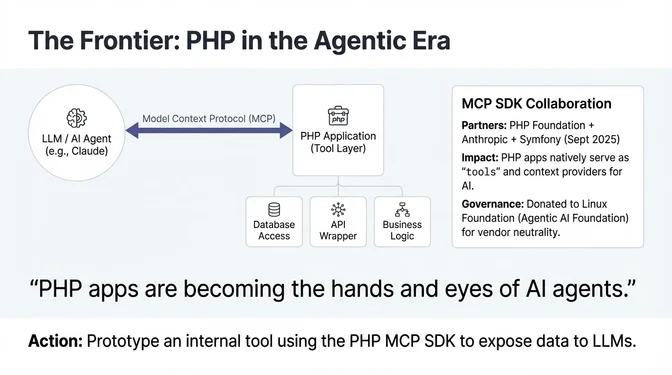
Infographic titled "The Frontier: PHP in the Agentic Era" illustrating how PHP applications integrate with AI agents through the Model Context Protocol (MCP). It shows an LLM or AI agent, such as Claude, communicating via MCP with a PHP application acting as a tool layer, which in turn provides database access, API wrappers, and business logic. A callout highlights MCP SDK collaboration between the PHP Foundation, Anthropic, and Symfony in September 2025, noting that PHP applications can natively serve as tools and context providers for AI. It also notes that Anthropic transferred governance to the Linux Foundation under the Agentic AI Foundation for vendor neutrality.
The Frontier: PHP's Role in the Agentic AI Era

When: Ongoing through 2026.
Context: PHP Foundation's official MCP SDK enables PHP applications to expose tools to AI systems. MCP donated to Linux Foundation (Agentic AI Foundation) with vendor-neutral governance strengthens long-term viability.
Action: Review MCP SDK for exposing PHP APIs to AI agents. Test integration patterns for Laravel/Symfony applications. Track MCP spec updates and tooling ecosystem growth.
Enjoyed this article?

Subscribe to get more deep-dives in your inbox.

Continue Reading

Stay ahead of the curve

Weekly deep-dives into programming languages, frameworks, and the tools shaping software engineering.