State of Python 2026
Python took its biggest technical leap in decades: Python 3.14 made free-threaded builds officially supported. PEP 703 introduced optional GIL removal; PEP 779 defined the criteria for "supported" status (Phase II). Single-thread overhead dropped from ~40% in 3.13 to typically single digits on common platforms, enabling ~3.1× speedups in multi-threaded CPU workloads. The GIL-optional era has begun, though C-extension wheel compatibility remains the primary adoption blocker.
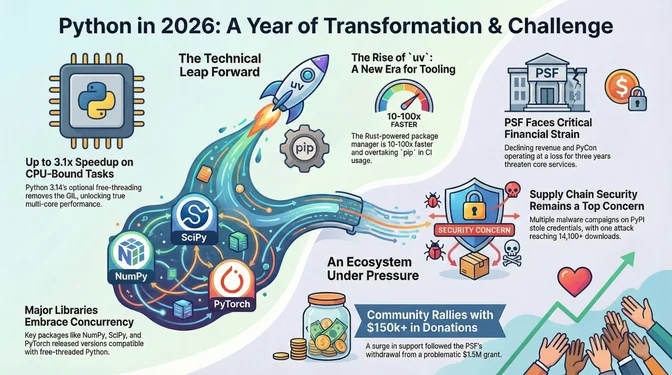
Tooling grew around uv, Astral's Rust-powered package manager now overtaking pip in CI usage for major projects (Wagtail: 66% uv vs 34% pip). Python 3.14 shipped template strings (PEP 750), deferred annotation evaluation (PEP 649), an experimental JIT, sub-interpreters in stdlib (PEP 734), and Sigstore-only signing (PEP 761) replacing PGP. SBOMs are now included in releases. Django turned 20 with 6.0 adding built-in background tasks and CSP. PyCharm merged editions: core features free, Pro features subscription.
The Python Software Foundation navigated financial pressure: declining revenue, PyCon running at a loss for three years, and a unanimous board vote to withdraw from a $1.5M NSF grant over incompatible terms. Community responded with $150K–$157K+ in donations and ~270–295 new Supporting Members (as reported over the following week), but institutional funding gaps remain.
Actions for 2026: Test Python 3.14 free-threaded builds (python3.14t) for CPU-bound workloads. Plan migration from Python 3.10 before October 2026 EOL. Try uv for package management and CI pipelines. Track free-threading wheel availability for key dependencies. Consider PSF Supporting Membership to address institutional funding gaps.
Python 2025 Timeline
January 2025
Django Security Releases
DeepSeek Malware on PyPI
February 2025
Python 3.13.2 and 3.12.9
March 2025
PyPI Cloud Token Malware Campaign
April 2025
Django 5.2 LTS
PEP 750 Approved
t"..." syntax enables custom processing of interpolated strings for safer SQL, HTML, and DSL generation.PyCharm Editions Merged
May 2025
Python Language Summit
June 2025
pandas 2.3.0
NumPy 2.3.0
July 2025
PyPy 7.3.20
EuroPython Documentary Preview
August 2025
PSF Grants Program Paused
Python Documentary Premieres
September 2025
pandas 2.3.3
October 2025
Python 3.14.0
PyTorch 2.9.0
PSF Withdraws from NSF Grant
State of Django 2025
Django Becomes CVE Numbering Authority
Python 3.9 End of Life
November 2025
PEP 810 Accepted
lazy import syntax can cut startup time by 50-70%.Django Security Release
QuerySet.filter() and related methods.JupyterLab 4.5.0
December 2025
Django Security Release
Django 6.0
MicroPython 1.27.0
Python 2026 Watchlist
1. Python 3.15 and Lazy Imports
When: October 2026 (expected release).
Context: PEP 810 adds opt-in lazy import syntax. Can cut startup time by 50-70% and reduce memory for CLI tools. Unlike rejected PEP 690, this is opt-in, preserving backward compatibility.
Action: Identify startup-sensitive applications (CLI tools, serverless functions) for early adoption testing.
2. Free-Threading Ecosystem Maturation
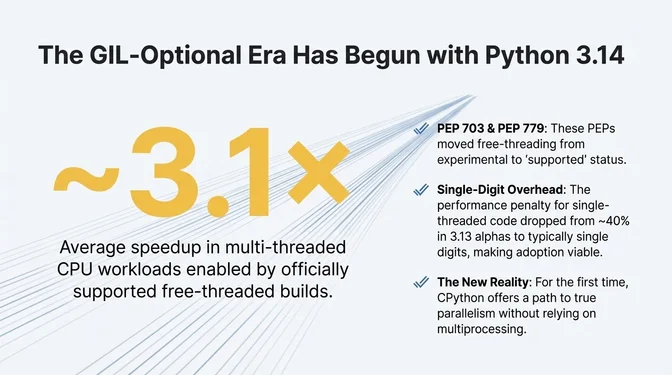
When: Ongoing through 2026. Technical foundation solid; library adoption is the bottleneck.
Context: NumPy 2.3.0 proved major libraries can transition. Blockers: many C-extension wheels aren't thread-safe, stable ABI doesn't support free-threaded builds, importing non-ready extensions can re-enable the GIL.
Action: Track announcements from key dependencies. Test CPU-bound workloads with python3.14t. File issues for libraries lacking 3.14t wheels.
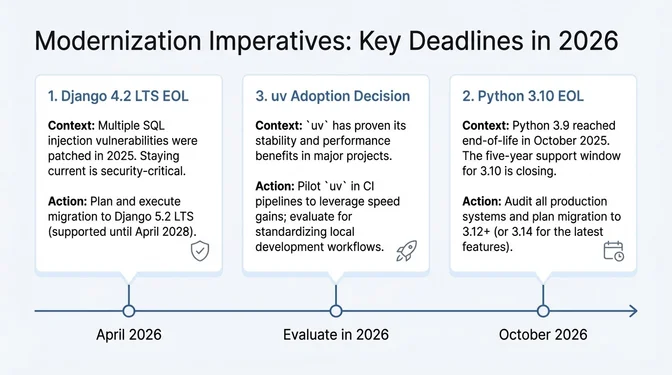
3. Python 3.10 End of Life
When: October 2026.
Context: Python 3.10 introduced structural pattern matching. Five-year support window ends. 3.9 already EOL (October 2025).
Action: Audit production systems. Plan migration to 3.12+ (or 3.14 for latest features).
4. PSF Sustainability
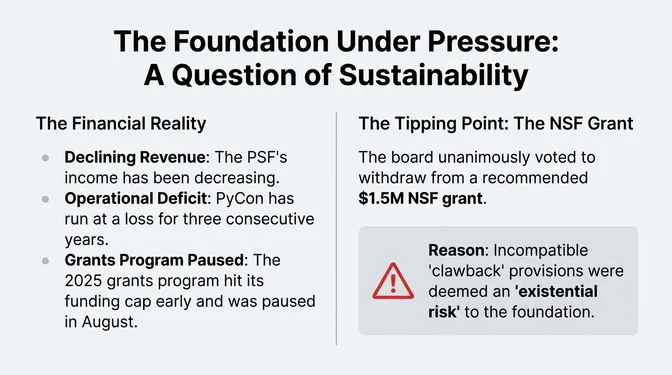
When: Critical in 2026. ~$5M annual budget, 14 employees, declining revenue.
Context: PyCon running at a loss for three years. Corporate sponsorship signups slowed. Grants program hit funding cap early. Individual donations surged ($150K-$157K+) but may not replace institutional funding at scale.
Action: Organizations using Python commercially should consider PSF sponsorship or Supporting Membership. This is the most important non-technical challenge facing the ecosystem.
5. JIT Compiler Progress
When: Python 3.15 (October 2026). 3.14's JIT was experimental.
Context: 3.15 JIT supports significantly more bytecode operations. 3-4% geometric mean improvement over standard interpreter; range from 20% slowdown to 100%+ speedup depending on workload.
Action: Benchmark long-running, CPU-bound applications with JIT-enabled builds when 3.15 releases.
6. uv Adoption Decision
!Infographic titled "The Tooling Renaissance: 'uv' Reshapes the Developer Workflow" describing Astral's Rust-based package manager, uv, becoming the high-performance standard for Python dependency management. It highlights a 10–100× speed improvement over pip plus virtualenv, shows uv overtaking pip in CI usage (66% vs. 34% in a Wagtail CI example), and lists key features including drop-in compatibility with pip, pip-tools, and virtualenv, support for existing requirements.txt files, and no lock-in to custom project formats.
When: Review in 2026. uv now majority CI share in some major projects.
Context: 10-100× faster than pip. Drop-in replacement for pip, pip-tools, virtualenv. Works with existing requirements.txt. No lock-in to custom conventions.
Action: Pilot uv in CI pipelines. Review for local development workflow standardization.
7. Django 4.2 LTS End of Life
When: April 2026. Django 5.2 LTS supported through April 2028.
Context: 75% use latest stable for new projects. the Django team patched SQL injection vulnerabilities in 2025; staying current is security-critical.
Action: If on Django 4.x, plan migration to 5.2 LTS before April 2026 EOL.
8. Supply Chain Security
When: Now. Python 3.14 ships with Sigstore-only signing (PEP 761) replacing PGP and includes SBOMs.
Context: Python ecosystem modernizing supply-chain security. PyPI continuing malware detection improvements. PSF's withdrawn grant would have funded automated package review tooling.
Action: Verify Sigstore signatures for Python releases. Audit dependency sources. Pin versions with hashes where possible.