State of Swift 2026
Three major transformations defined Swift's 2025: the philosophical pivot from strict enforcement to "Approachable Concurrency" in Swift 6.2 (reducing annotation fatigue while maintaining data-race safety), unprecedented platform expansion with official Android SDK and WebAssembly compilation, and industrial validation through Apple's Password Monitoring Service case study (40% performance improvement, 50% capacity reduction for billions of daily requests). The year began with community pushback against Swift 6's strict concurrency model and culminated in Swift 6.2's pragmatic reconciliation of safety with developer ergonomics, alongside AWS re:Invent's Swift announcements: Lambda experimental runtime interface client and Swift 6.2.1 toolchain packaging in Amazon Linux 2023.
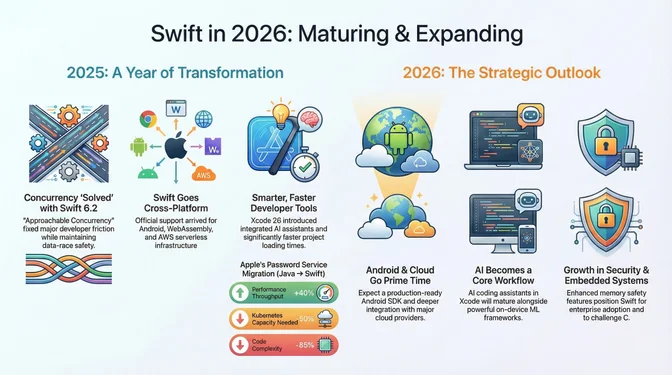
The ecosystem faced significant architectural debates, most notably The Browser Company's pivot away from SwiftUI for their Dia browser citing performance bottlenecks, while Swift's popularity rankings declined (TIOBE dropped to 26th despite deepening production usage). By year's end, server-side Swift reached production maturity, VS Code workflows improved with background indexing and swiftly integration, and Xcode 26 introduced integrated AI assistants with model choice. The disconnect between declining popularity and increasing ecosystem investment reveals Swift's strategic positioning: fewer total developers, but deeper integration across Apple platforms, server infrastructure, embedded systems, and now Android.
Actions for 2026: Adopt Swift 6.2's approachable concurrency defaults; review Android SDK for cross-platform business logic; track Swift 6.3 for embedded improvements; test WebAssembly support for edge computing.
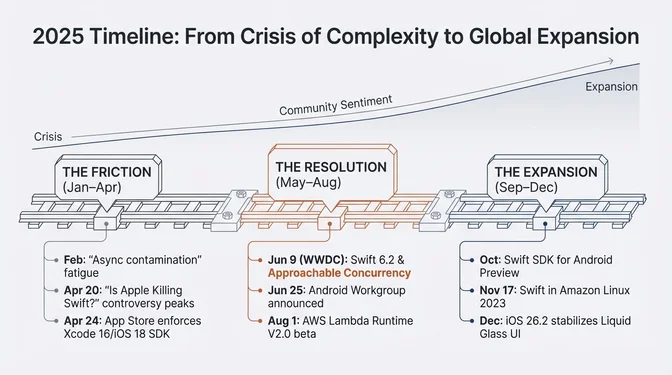
Swift 2025 Timeline
January 2025
CVE-2025-0343 Fix
iOS Conf SG 2025
Swift Playgrounds 4.6
February 2025
gRPC Swift 2
March 2025
Swiftly 1.0
Swift 6.1
@implementation attribute for Objective-C category implementations, extended nonisolated keyword, TaskGroup type inference, trailing commas everywhere, package traits for conditional dependencies, and background indexing for SwiftPM projects. April 2025
Swift Heroes 2025
try! Swift Tokyo 2025
"Is Apple Killing Swift?"
App Store Policy Change
Deep Dish Swift
May 2025
Swift Craft
Server Workgroup Update
Swift 6.1.1
Xcode 16.4
Swift 6.1.2
June 2025
Password Tracking Case Study
Swift Package Index 5th Anniversary
WWDC 2025
Swift 6.2 Preview
@concurrent attribute for explicit parallelism, and inferred isolated conformances.Safe Systems Programming Features
InlineArray<N, Element> for stack-allocated fixed-size collections (20-30% faster in benchmarks), Span type for safe memory views without ARC overhead, and opt-in strict memory safety mode.WebAssembly Support
Embedded Swift Maturation
any types, and roadmap for Swift 6.3 improvements: floating-point printing, @c attribute, @section/@used attributes, enhanced LLDB debugging.Xcode 26
SwiftUI Enhancements
C++ and Java Interop
Foundation Models Framework
Android Workgroup
July 2025
Swift 6.2 Analysis
August 2025
AWS Lambda Runtime V2 Beta
September 2025
Swift 6.2 GA
-default-isolation MainActor), migration support for async functions running in caller context, WebAssembly support (deploy to the browser or other runtimes), and systems programming features (InlineArray, Span, strict memory safety mode). Xcode 26 and new platform versions available (iOS 26, macOS Tahoe 26, etc.) with unified versioning across all platforms.Swift 6.2 Feedback
October 2025
Server-Side Swift Conference
AWS Lambda Runtime V2 GA
Swift Connection 2025
Android SDK Preview
Pragma Conference
November 2025
Swift 6.2.1
AWS Lambda Runtime to AWSLabs
FreeBSD Preview
Temporal Swift SDK
Do iOS
Swift 6.3 Release Process
AWS re:Invent
dnf install -y swiftlang), and Lambda adds experimental Swift runtime interface client.December 2025
Swift 6.2.2
iOS 26.2
Year-End Newsletter
SwiftUI Maturity
Concurrency: From Strict to Approachable
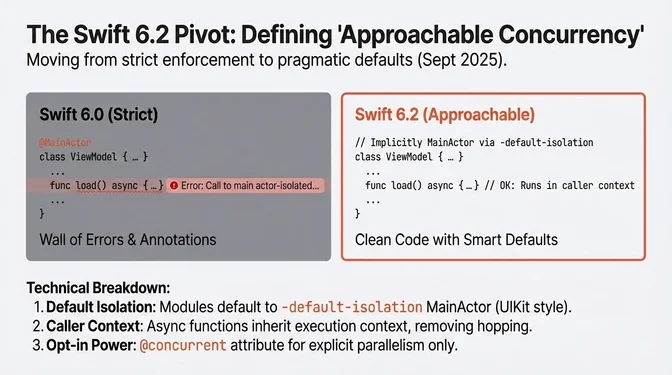
Swift 6.0's strict concurrency created friction. Developers faced "async contamination" and annotation fatigue. Swift 6.2's "Approachable Concurrency" philosophy pivoted to pragmatism while maintaining safety:
-default-isolation MainActor: Modules default to main actor isolation, returning to how UIKit apps worked for years- Caller context execution: Async functions run in caller's context (migration support for upcoming default)
- `@concurrent` attribute: Explicit opt-in for parallel execution
- Swift 6.1 ergonomics: Extended
nonisolatedto types/extensions, TaskGroup type inference,@implementationfor Obj-C categories
Platform Expansion
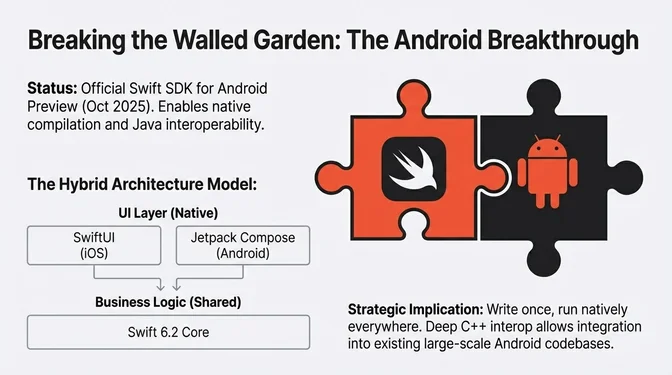
Android: The Swift SDK for Android preview (October) enables direct compilation, Java interop, and shared business logic. Skip shows hybrid architectures: compiled Swift logic with platform-specific UI.
WebAssembly: Swift 6.2 support enables browser execution and potential deployment on Cloudflare Workers (experimental WASI) and Fastly Compute.
Embedded: Swift 6.2 brought full String APIs and InlineArray/Span. Swift 6.3 adds floating-point printing, @c attribute, enhanced LLDB, positioning Swift to challenge C in education/hobbyist markets.
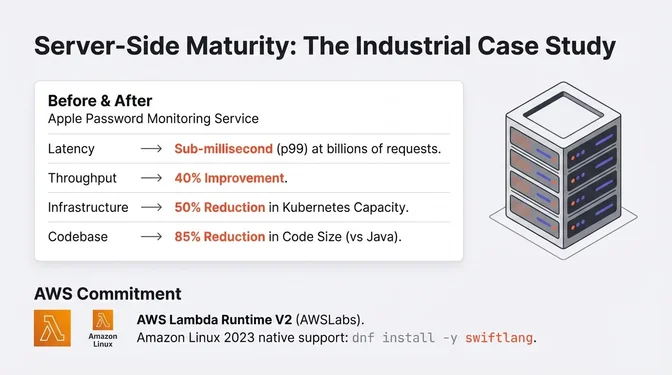
Server-Side: Apple's Password Monitoring Service migration (Java → Swift) delivered +40% throughput, -50% Kubernetes capacity, -85% code complexity, sub-ms p99 latency at billions of daily requests. AWS re:Invent brought Amazon Linux 2023 Swift packages and Lambda Runtime V2 in AWSLabs.
SwiftUI Controversy
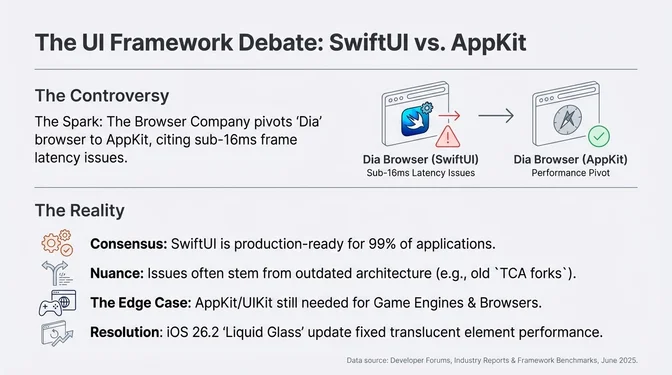
The Browser Company's pivot from SwiftUI to AppKit for their Dia browser sparked intense debate. They cited latency, hitching, and CPU overhead for sub-16ms frame time requirements. Community analysis suggested implementation issues (outdated TCA fork, improper state management) rather than framework limitations. Consensus: SwiftUI is production-ready for most apps; AppKit/UIKit remain essential for extreme performance (browsers, games, creative tools). iOS 26.2 improved Liquid Glass frame times.
The "Is Apple Killing Swift?" debate (April) criticized language bloat (200+ keywords) and governance tensions, though defenders noted 2025's community-driven cross-platform improvements.
Security & Systems Programming
Memory safety features: `InlineArray` provides 20-30% faster stack-allocated collections; Span offers zero-overhead safe memory views; -strict-memory-safety mode (adopted in WebKit, Messages) flags unsafe constructs. WebKit zero-days (CVE-2025-43529, CVE-2025-14174) reinforced urgency for Swift rewrites. NSA/CISA guidance recommends Swift alongside Rust.
Interoperability: Deep C++ interop (templates, protocols, bidirectional memory) and Swift-Java bridge enable incremental adoption in large codebases and Android development.
Developer Tooling
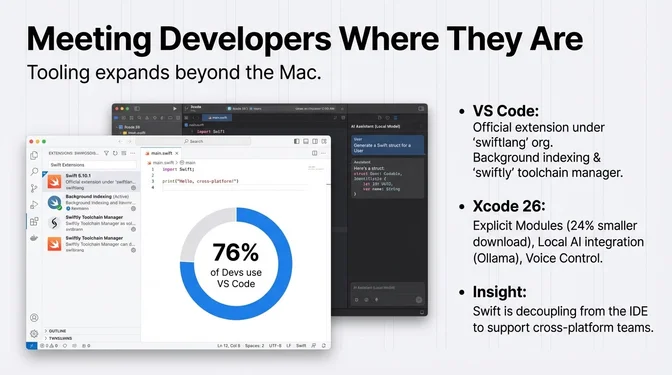
Xcode 26: Integrated AI assistant (ChatGPT built-in, more providers via API key, local models via Ollama/LM Studio), 24% smaller download, 40% faster workspace loading, #Playground macro, Voice Control for Swift.
VS Code: Official Swift extension transferred to swiftlang org with background indexing (Swift 6.1 default), Test Explorer, and swiftly integration. With 76% of developers using VS Code, Swift now meets developers where they are.
Market Position
Rankings declined despite ecosystem growth: TIOBE 26th, Stack Overflow 5.4% usage (but 65.9% admired), RedMonk 11th, PYPL 9th. Salaries remain strong: $118K–$124K average, up to $200K senior, ~15% annual job growth. The pattern suggests depth over breadth: fewer total developers but deeper integration and higher value per developer.
Governance
Workgroup reorganization renamed groups to "Steering Groups" and added Ecosystem Steering Group and Contributor Experience Workgroup. Community pushed for swift.org improvements and documentation updates tied to proposal acceptance. By year's end, full Swift 6 documentation addressed earlier gaps.
Swift 2026 Watchlist
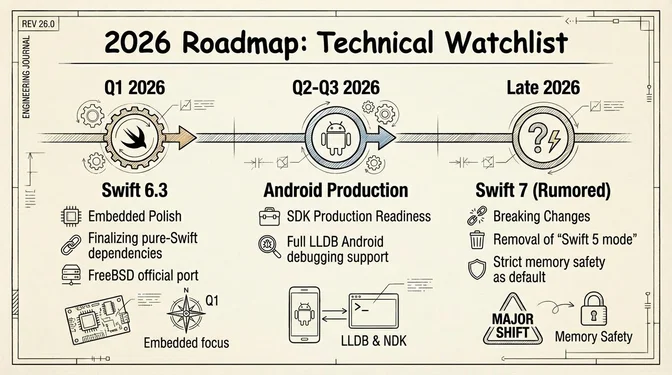
1. Swift 6.3: Embedded Systems and Polish
When: Q1 2026
Context: The Swift 6.3 release will finish the Embedded Swift feature set with improvements including pure-Swift floating-point printing (eliminating C library dependencies), @c attribute for C-compatible function exports, @section and @used attributes for linker control, enhanced LLDB debugging for embedded targets, and Swift MMIO for memory-mapped I/O with SVD-based code generation. This brings the full standard library to bare-metal targets.
Action: Review Embedded Swift for hobbyist electronics projects (Arduino, Raspberry Pi Pico) and track for production embedded systems adoption. Swift positions itself to challenge C in education and embedded markets.
2. Android SDK Production Readiness
When: Q2-Q3 2026 (alongside Swift 6.3 or 6.4)
Context: The Android Workgroup's vision guides development toward official SDK stable release, debugging enhancements (full LLDB support), IDE integration (Android Studio and VS Code extensions), and package compatibility (major Swift packages working on Android). Tools like Skip show viability of hybrid architectures: compiled Swift for business logic with platform-specific UI (SwiftUI for iOS, Jetpack Compose for Android).
Action: Begin planning cross-platform architecture with Swift as the universal logic language. Prototype shared business logic layers and review Skip for UI mapping vs. the official SDK for direct compilation.
3. Swift 7 and Breaking Changes
When: Late 2026 (speculative)
Context: Rumors of Swift 7 are consistent with the language's lifecycle. A major version update would likely complete the strict concurrency transition (potentially deprecating "Swift 5 language mode"), stabilize non-copyable types (ownership and borrow checking), finish memory safety features (making strict mode default), and remove "training wheels" (data isolation enforcement without opt-out). The Swift Core Team has hinted that once Swift 6.x achieves its goals, Swift 7 could focus on larger-scale changes deferred from earlier editions, including variadic generics beyond parameter packs and reevaluation of older decisions with breaking changes.
Action: Plan for major migration work if Swift 7 ships. Begin adopting Swift 6.2's approachable concurrency defaults now to ease future transitions. Track Swift Evolution proposals for breaking changes discussion.
4. AWS and Cloud Platform Expansion
When: Throughout 2026
Context: After AWS's re:Invent endorsement (Amazon Linux 2023 Swift packages, Lambda Runtime in AWSLabs), 2026 could be a breakout year for Swift in the cloud. Expect stable 1.0 release of AWS Swift SDK, Lambda runtime refinements, and potential Swift functions on Google Cloud Run or Azure Functions. Swift's memory safety and performance attract adopters in fintech and backend systems as security concerns drive organizations toward memory-safe languages. Vapor 5 promises complete async/await rewrite and shared HTTP server implementation.
Action: Review Swift for Backend for Frontend (BFF) patterns, leveraging shared data models, validation logic, and business rules between iOS and server. Track cloud provider announcements for expanded Swift support.
5. AI-Integrated Development Workflows
When: Throughout 2026
Context: Xcode 26's integrated AI assistant (ChatGPT built-in, more providers via API key, local models via Ollama/LM Studio) represents the beginning of AI-integrated development workflows. Swift's clarity and strong type system make it well-suited for LLM code generation since the compiler catches hallucinations that would cause runtime errors in dynamic languages. Expect Xcode 17 (2026) to specifically leverage Swift's type safety to verify AI-generated code in real-time. Apple's Foundation Models framework will mature with more APIs for Swift developers utilizing neural engines, Swift DSL for ML tasks, Python interop improvements, and streamlined model deployment tools. MLX and Hugging Face's Swift packages continue to expand as Hugging Face released swift-huggingface for Swift developers.
Action: Integrate AI coding assistants into daily workflows and provide feedback on Swift-specific capabilities. Experiment with Foundation Models framework for on-device ML inference. Track MLX and Hugging Face developments for ML use cases on Apple Silicon.
6. WebAssembly Ecosystem Growth
When: Throughout 2026
Context: Swift 6.2's official WebAssembly support positions Swift to compete with AssemblyScript (TypeScript-like syntax), Rust (current performance leader), and Go (TinyGo for small binaries). Continued toolchain improvements will enable use cases including browser applications, edge computing (potential deployment on platforms with WASI support like Cloudflare Workers and Fastly Compute), and plugin systems (Wasm-based extensibility).
Action: Prototype Swift for WebAssembly in edge computing scenarios. Review for browser-based applications where Swift's type safety and performance outweigh JavaScript's ecosystem advantages. Track toolchain improvements for production readiness.
7. SwiftUI Performance and Hybrid Architectures
When: Throughout 2026
Context: The Browser Company controversy and iOS 26.2's performance improvements show that while SwiftUI is production-ready for most applications, performance ceilings exist for extreme scenarios. The community consensus by year's end: SwiftUI is the future for most development, but AppKit/UIKit remain essential for browsers, creative tools, games, and system utilities requiring extreme performance. SwiftUI Instruments template provides unprecedented visibility into view body updates through cause-and-effect graphs.
Action: Use SwiftUI for standard applications while maintaining hybrid architectures for performance-critical paths. Master the SwiftUI Instruments template for performance debugging. For applications requiring sub-16ms frame times with complex state, review AppKit/UIKit for critical rendering loops.
8. FreeBSD and Beyond: Unix Platform Expansion
When: Q1 2026 (FOSDEM 2026 talk)
Context: With FreeBSD support becoming official in 2026, Swift will run on all major \*nix platforms. This opens doors to network appliances (FreeBSD-based routers and firewalls), research computing (academic institutions on BSD), and high-security systems (potential future OpenBSD compatibility).
Action: Track FreeBSD port progress for server deployments requiring BSD's networking stack or ZFS. Review for research computing environments already standardized on BSD.
9. Conference and Community Growth
When: Throughout 2026
Context: try! Swift Tokyo 2026 already planned for April. FOSDEM 2026 (late January) will feature pre-FOSDEM Swift Community Event and FreeBSD porting talk. Expect continuation of Server-Side Swift Conference, Swift Connection, SwiftLeeds, NSSpain annual European circuit, and emerging markets events in Asia, Latin America, and Africa. Swift Package Index exploring package metrics (quality scores, health indicators), verification program (trusted package badges), and corporate sponsorship models like how Apple sponsored Swift Package Index.
Action: Attend conferences to stay current on ecosystem developments. For library maintainers, prepare for Swift Package Index quality metrics and verification programs. Consider corporate sponsorship of core libraries as ecosystem investment.
10. Security-Driven Adoption in Government and Enterprise
When: Throughout 2026
Context: Swift 6.2's strict memory safety mode aligns with NSA and CISA guidance recommending memory-safe languages. This positions Swift well for defense contracting (government projects requiring certified memory safety), financial services (high-security banking and payment systems), healthcare (HIPAA-compliant applications), and critical infrastructure (industrial control systems and utilities). The faster Apple rewrites low-level subsystems in Swift using Span and InlineArray, the fewer legacy C++ vulnerabilities like the WebKit zero-days (CVE-2025-43529, CVE-2025-14174) will remain.
Action: For organizations in regulated industries, review Swift's memory safety guarantees against compliance requirements. Adopt strict memory safety mode for security-critical code paths. Track government and enterprise adoption announcements as validation signals.