State of WebAssembly 2026
WebAssembly had a strong 2025 with the release of WebAssembly 3.0, bringing garbage collection, 64-bit memory addressing, and exception handling to the specification. These additions expanded what languages can target Wasm efficiently. Java, Kotlin, Dart, and Scala can now rely on the engine's GC for memory management instead of shipping a full GC implementation. Chrome Platform Status metrics put WebAssembly usage at ~5.5% of Chrome page loads (page loads using the feature at least once, up from ~4.5% a year earlier), while the Web Almanac found only 0.35% of sites explicitly load .wasm files. Enterprise adoption at Google and Cloudflare proved Wasm's production viability, with American Express publicly describing internal platform work. The "invisible" success of Wasm in the browser became evident: it now powers critical infrastructure from Figma's rendering engine to Adobe Photoshop on the web, often without developers being explicitly aware of the underlying binary format.
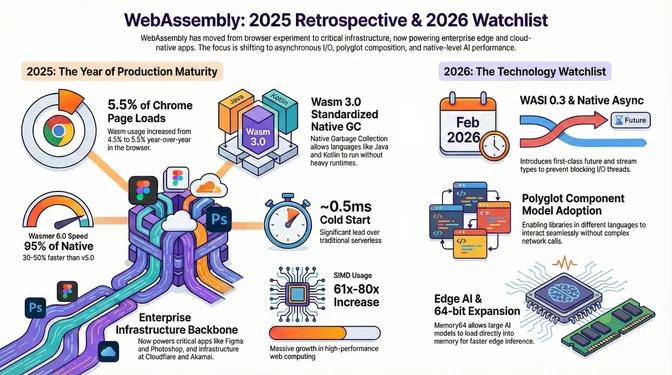
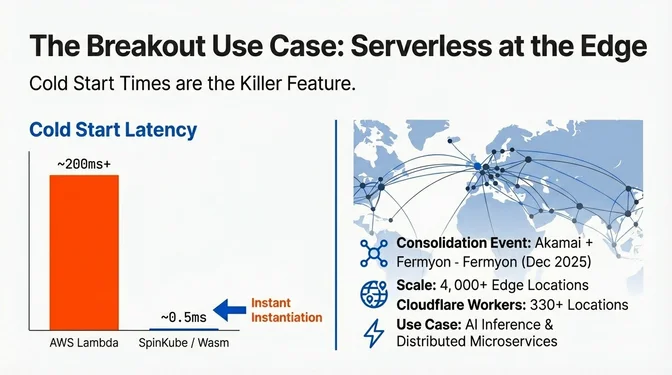
The year delivered major tooling advances alongside specification progress. Wasmtime earned Core Project status from the Bytecode Alliance and shipped monthly releases through version 41, progressively adding Wasm 3.0 features, while Wasmer 6.0 achieved 95% of native speed on compute benchmarks with 30-50% speedups over v5.0. Microsoft released Wassette to bridge Wasm Components with AI assistants via the Model Context Protocol, and Safari 18.4 improved WebAssembly execution in JIT-disabled environments, bringing Apple's browser closer to parity with Chrome and Firefox. Edge computing emerged as Wasm's breakout use case. Cloudflare Workers runs across 330+ global locations, Fastly Compute offers microsecond-level Wasm instantiation, culminating in Akamai's acquisition of Fermyon to power serverless functions across 4,000+ global edge locations.
The year also exposed growing pains. The Rust team is archiving the rustwasm GitHub organization, with wasm-bindgen transferring to new maintainers and wasm-pack moving to long-time maintainer Jesper Håkansson. Developers on Rust forums expressed concern about deprecation of foundational crates. A contentious "identity crisis" debate erupted over Wasm's direction, with Cloudflare's Sunil Pai characterizing the divide: "System engineers don't give a damn about browsers and UI engineers." A "Brutally Honest Guide to WebAssembly in 2025" made the rounds, separating genuine strengths from areas Wasm isn't yet suited for. Security required vigilance: Chrome patched several V8 zero-days in 2025, with Google noting exploits existed in the wild
, and the Shai-Hulud supply chain attack compromised ~800 npm packages including components from Zapier, ENS Domains, PostHog, and Postman. The Bytecode Alliance marked the milestone with "10 Years of Wasm: A Retrospective", reflecting on Wasm's journey from browser experiment to critical infrastructure. Looking ahead, WASI 0.3 targets February 2026 with native async support, setting the stage for WASI 1.0 standardization.
Actions for 2026: Upgrade to WASI 0.3 when it ships for native async I/O support. Adopt the Component Model for polyglot module composition. Review Wasmtime LTS releases for 2-year security support on production deployments.
WebAssembly 2025 Timeline
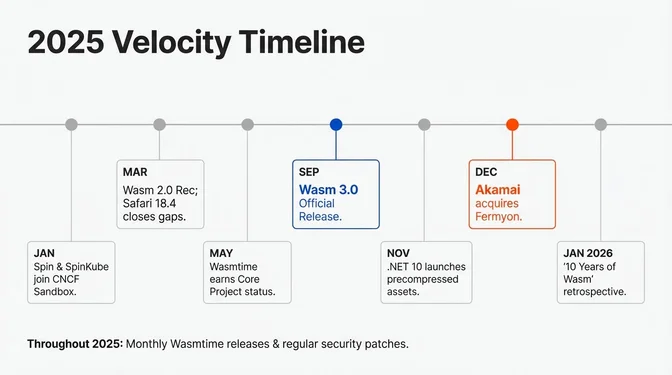
January 2025
WebAssembly Workshop at POPL
Spin and SpinKube Join CNCF
February 2025
FOSDEM 2025
WASI Preview 2 Adoption
March 2025
SpinKube at SUSECON
Wasm 2.0 Officially Recognized
SpecTec Adoption
Wasm I/O 2025
Safari 18.4 Closes Gaps
April 2025
Component Model Progress
Wasmer 6.0
Wasmtime Core Project Status
May 2025
WASI Subgroup Timeline
June 2025
Wasmtime 34.0.0
July 2025
CVE-2025-53901 Patched
rustwasm Organization Archive
August 2025
WasmEdge v0.15.0
Wassette Released
Wasmtime 36.0.0 LTS
September 2025
Kotlin 2.2.20
GitHub MCP Registry
WebAssembly 3.0
Wasmtime 37.0.0
Chrome V8 Zero-Day (CVE-2025-10585)
Shai-Hulud Supply Chain Attack
Wasmer Edge Python Support
Safari Technology Preview 227
WebAssembly.Memory.prototype.toFixedLengthBuffer() and .toResizableBuffer(), enabling conversion between fixed-length and resizable memory buffers for more flexible memory management.October 2025
Firefox CVE-2025-13016 Discovered
Uno Platform 6.3
Type Reflection Proposal Demotion Discussion
RedMonk "Identity Crisis" Analysis
CVE-2025-62711 (Wasmtime)
Spin 3.5.0
November 2025
.NET 10
Wasmtime CVE-2025-64345 Patched
Firefox 145 Enables Relaxed SIMD
Web Almanac 2025 Published
Chrome CVE-2025-13223 Patched
Wasmtime 39.0.0
WordPress Playground Xdebug Support
December 2025
Akamai Acquires Fermyon
Go 1.25.5 Security Release
CVE-2025-69261 (WasmEdge)
January 2026
wasm-pack v0.14.0
10 Years of Wasm
Wasm 3.0 and Performance
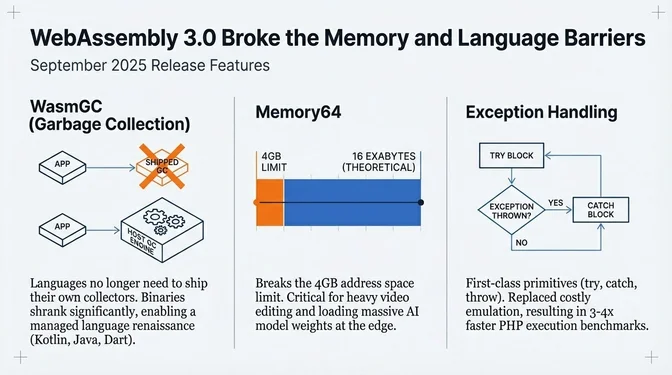
WebAssembly 3.0 delivered major capabilities. Memory64 broke the 4GB barrier, extending addressable space to 16 exabytes in theory (browsers impose tighter caps, e.g., 16 GB on the web), critical for video editing, scientific simulation, and LLM inference at the edge where Cloudflare and Fermyon load massive AI model weights directly into memory. WasmGC eliminated the need for managed languages to bundle their own garbage collectors, shrinking multi-megabyte binaries and enabling Google Sheets to migrate its calculation engine from JavaScript to WasmGC-compiled Java with 2× performance gains. WasmGC shipped in Chrome 119 (Oct 2023) and Firefox 120 (late 2023), with Safari 18.2 following, achieving cross-browser baseline availability by late 2024. Exception handling introduced first-class primitives (try, catch, throw) with the exnref value type, where Wasmer benchmarks showed 3-4× faster PHP execution. Wasmer 6.0 reports its LLVM backend within ~5% of native on Coremark, illustrating how close modern runtimes can get to native performance on compute benchmarks.
Ecosystem and Adoption
The HTTP Archive's Web Almanac 2025 found WebAssembly on 0.35% of desktop sites, modest numbers masking significant growth in specific verticals where the top 1,000 sites show much higher adoption. Figma maintains its C++ rendering engine achieving 3× faster load times, Google uses Wasm across Maps, Earth, Meet, and Photos, and Adobe's Photoshop Web handles complex rendering in-browser. Rust remains the ecosystem leader with tooling years ahead of alternatives. Wasmtime shipped monthly releases through version 41, progressively adding Wasm 3.0 features, with an LTS release channel (every 12th release) providing 2-year security support, while Wasmer 6.0 achieved 95% native speed with 30-50% speedups over v5.0. WasmGC sparked a managed language renaissance: Kotlin's Wasm compiler reached Beta, and developers are running WordPress entirely in the browser.
Security Landscape
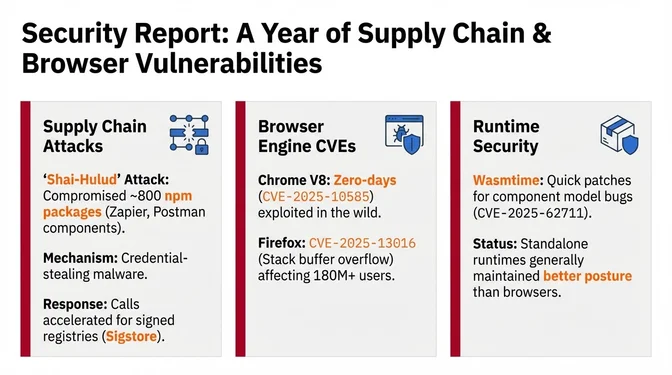
Chrome patched several V8 zero-days in 2025 confirmed exploited in the wild
, including type-confusion bugs like CVE-2025-10585 and CVE-2025-13223 that could potentially allow heap corruption via a crafted HTML page. Firefox's CVE-2025-13016 (WasmGC stack buffer overflow, CVSS 7.5) affected 180+ million users. Standalone runtimes maintained better security posture with lower-severity advisories. The Shai-Hulud 2.0 campaign compromised ~800 npm packages including components from Zapier, ENS Domains, PostHog, and Postman. Separately, attackers compromised `@duckdb/duckdb-wasm@1.29.2` in a different September 2025 incident. These attacks prompted CISA alerts and accelerated calls for dedicated Wasm registries with cryptographic signing. Most 2025 incidents were in browser engines (e.g., V8 vulnerabilities) or supply-chain compromises, rather than in the Wasm specification itself.
Community and Challenges
The Bytecode Alliance grew to dozens of members including Fastly, Microsoft, Google, Intel, and Mozilla, while the CNCF hosts several Wasm projects with wasmCloud advancing to incubator status.
Yet tensions emerged publicly. Wasmer's 2019 attempt to trademark "WebAssembly" drew criticism until their CEO issued a formal apology. A contentious "identity crisis" debate erupted over Wasm's direction, and developers voiced frustration that DOM access remains unavailable nearly 8 years after Wasm's debut. The industry solidified around a hybrid architecture: Wasm handles heavy computation while JavaScript manages UI, explaining why despite only ~0.35% of sites explicitly loading .wasm files, actual reach is far more ubiquitous through third-party scripts and embedded modules.
WebAssembly 2026 Watchlist
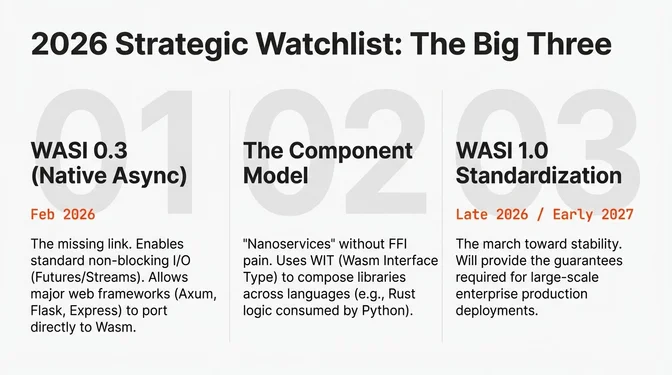
1. WASI 0.3 with Native Async
When: February 2026
Context: WASI 0.3 brings native asynchronous I/O to the Component Model, enabling language-integrated concurrency with idiomatic bindings. Previous WASI versions were synchronous; HTTP requests blocked execution threads. WASI 0.3 introduces first-class future and stream types, allowing host runtimes to suspend waiting components and schedule other work. Follow-on 0.3.x releases will add cancellation tokens, stream optimizations, and threads. Once the spec standardizes async, expect robust ports of major web frameworks (Axum, Flask, Express alternatives) targeting WASI directly.
Action: Track Wasmtime and Wasmer releases for WASI 0.3 support. Plan migration of I/O-heavy Wasm services to leverage async APIs.
2. WASI 1.0 Standardization
When: Late 2026 or early 2027
Context: As The New Stack noted: "You won't know when WebAssembly is everywhere in 2026." WASI 1.0 will standardize the system interface for production deployments, providing stability guarantees that enterprise adopters require.
Action: Track the WASI roadmap and join feedback cycles for preview releases.
3. Component Model Adoption
When: Throughout 2026
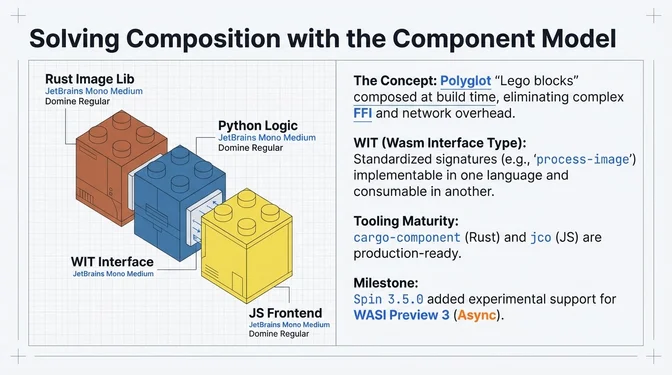
Context: The Component Model enables polyglot module composition where libraries in different languages interact without network calls or FFI complexity. WIT (Wasm Interface Type) allows defining cross-language function signatures. For example, process-image(data: list can be implemented in Rust but consumed by Python or JavaScript. Wasmtime solidified support, enabling "nanoservices" composed at build time rather than over networks.
Action: Experiment with cargo-component for Rust or jco for JavaScript. Consider component-based architectures for new services.
4. JavaScript Promise Integration (JSPI)
When: Q1-Q2 2026
Context: JSPI is Phase 4 and available in Chrome 137+ and Firefox 139+; Safari support remains the open question. JSPI enables Wasm to call async JavaScript APIs smoothly without workarounds, critical for web applications using fetch, IndexedDB, or Web Crypto.
Action: Test JSPI in Chrome for async-heavy Wasm applications. Watch Safari Technology Preview for implementation progress.
5. Stack Switching Proposal
When: Phase 3, targeting 2026 implementation
Context: Stack Switching enables managing multiple execution stacks via continuations, supporting async/await, coroutines, and generators natively in Wasm. This unlocks efficient implementation of green threads and cooperative multitasking for languages like Go and Kotlin.
Action: Follow prototype implementations in Wasmtime. Review impact on language runtimes targeting Wasm.
6. WASI Networking & Sockets
When: 2026
Context: While WASI so far focused on files and clocks, network sockets are in development. 2026 could see WASI sockets and HTTP become standardized, allowing Wasm programs to open TCP/UDP sockets directly in a portable way. Cloudflare and others are experimenting.
Action: Track WASI proposals for wasi-sockets and wasi-http stabilization. Review implications for server applications in Wasm.
7. WebAssembly CSP Standardization
When: 2026
Context: Security teams increasingly demand control over Wasm execution. The WebAssembly Content Security Policy proposal will allow site operators to whitelist specific Wasm binary hashes, mitigating risks from malicious third-party code.
Action: Prepare hash inventories of production Wasm modules. Plan CSP header updates when the proposal reaches implementation.
8. .NET 11 CoreCLR Preview
When: Late 2026 preview, shipping in .NET 12 (2027)
Context: .NET 11 will preview the new CoreCLR runtime for WebAssembly, unifying execution models across server and client. Microsoft and Uno Platform are collaborating on multithreading support. Full WasmGC integration remains a multi-year effort. Kotlin Multiplatform could move its Wasm target from beta to stable. OpenJDK's Project Valhalla is experimenting with Wasm backend for Java-to-Wasm compilation.
Action: Test .NET 11 previews for Blazor WebAssembly applications. Review AOT compilation benefits from .NET 10 as a stepping stone.
9. DOM and UI Integration
When: Ongoing, potentially 2026 proposal
Context: A perennial question: will Wasm ever directly manipulate the DOM? There's no official proposal yet, but there is interest in Web IDL bindings for Wasm to call web APIs directly. Perhaps 2026 will see a formalized proposal, or a subset like DOM access via Component Model. At least, libraries like web-sys for Rust will improve to make DOM calls from Wasm less painful.
Action: Watch W3C WebAssembly Community Group meetings for DOM-related proposals. Consider hybrid architectures (Wasm compute + JS UI) for current projects.
10. Wasm I/O 2026
When: March 19-20, 2026
Context: Wasm I/O 2026 runs at the AXA Convention Center in Barcelona. The CFP closed December 24, 2025. WasmCon 2026 runs in Amsterdam in March, co-located with KubeCon Europe.
Action: Register for tickets. Watch for schedule announcements.
11. Edge AI Inference
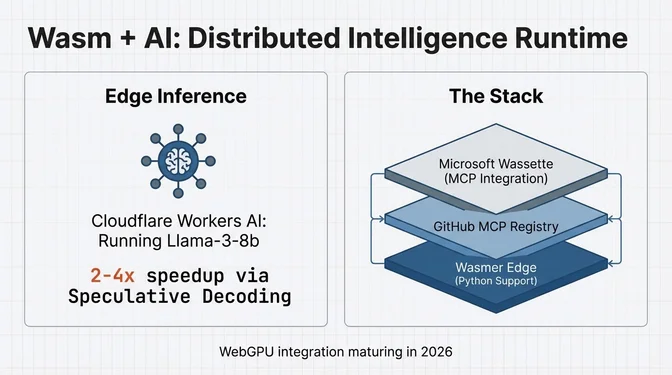
When: Now and expanding throughout 2026
Context: Cloudflare Workers AI runs models like Llama-3-8b at the edge with Speculative Decoding achieving 2-4× inference speedups. Wasmer Edge supports Python frameworks for AI workloads. Wasm's 64-bit memory and portability make it ideal for distributed inference. With WebGPU integration, 2026 will see sophisticated models running entirely within the browser via Wasm.
Action: Review edge AI platforms for latency-sensitive inference. Test Memory64 support for large model deployments.
12. Hardware and Platform Developments
When: Throughout 2026
Context: Companies like Intel have been thinking about Wasm-specific CPU instructions or co-processors. There's talk of a Linux in-kernel Wasm interpreter for sandboxing eBPF-like tasks. Projects like Wasm3 and WAMR may announce full WASI on tiny IoT devices, enabling a unified programming model from cloud to microcontroller.
In the mobile space, WebAssembly is coming via WebViews and possibly React Native plugins for heavier logic. Other proposals to watch include Extended Constant Expressions (more compute at compile-time), Memory64 improvements (engines optimizing for 32-bit where possible), and new instruction sets for crypto or bit manipulation akin to what x86 added. WAPM (WebAssembly Package Manager) exists but is quiet; 2026 might revive it or something new to host shared Wasm modules. Sigstore suggestions for signing .wasm files to verify modules in registries and prevent tampering are gaining traction.
Action: Follow announcements from Intel, ARM, and Linux kernel mailing lists. Consider Wasm for embedded and mobile use cases.
13. Continued Adoption Growth
When: Throughout 2026
Context: Chrome Platform Status data shows Wasm usage rising year-over-year (roughly ~4.5% → ~5.5% of Chrome page loads in 2025), suggesting continued growth. Major SaaS platforms may move more functionality to Wasm, and popular game engines may adopt Wasm for web publishing.
Action: Assess Wasm skills gaps in your team. Consider the Wasm stack (Rust, WIT, WASI) for career development.
14. ESM Source Phase Imports
When: 2026
Context: The TC39 Source Phase Imports proposal (Stage 3) enables cleaner Wasm module loading: import source FooModule from "./foo.wasm"; returns a WebAssembly.Module for manual instantiation. This is a stepping stone toward full ESM integration where import { add } from "./math.wasm" just works. V8 implemented this in M131, and Node.js integration is in progress. Benefits include better static analysis for bundlers and eliminating the need for wasm-unsafe-eval CSP directives.
Action: Track V8 and SpiderMonkey implementations. Test with bundlers that support the new import syntax.
15. Wide Arithmetic Proposal
When: Phase 3, targeting 2026 implementations
Context: The Wide Arithmetic proposal adds native 128-bit integer operations (i64.add128, i64.sub128, i64.mul_wide_s/u) to WebAssembly. Currently, 128-bit arithmetic requires 64-bit instruction sequences or library calls, running 2-7× slower than native. Benchmarks show fib_10000 goes from 120% slower-than-native to just 9% on x86_64 with these instructions. Critical for cryptography, big-integer math, and financial calculations.
Action: Watch runtime implementations in Wasmtime and V8. Assess impact on crypto and big-number libraries targeting Wasm.